
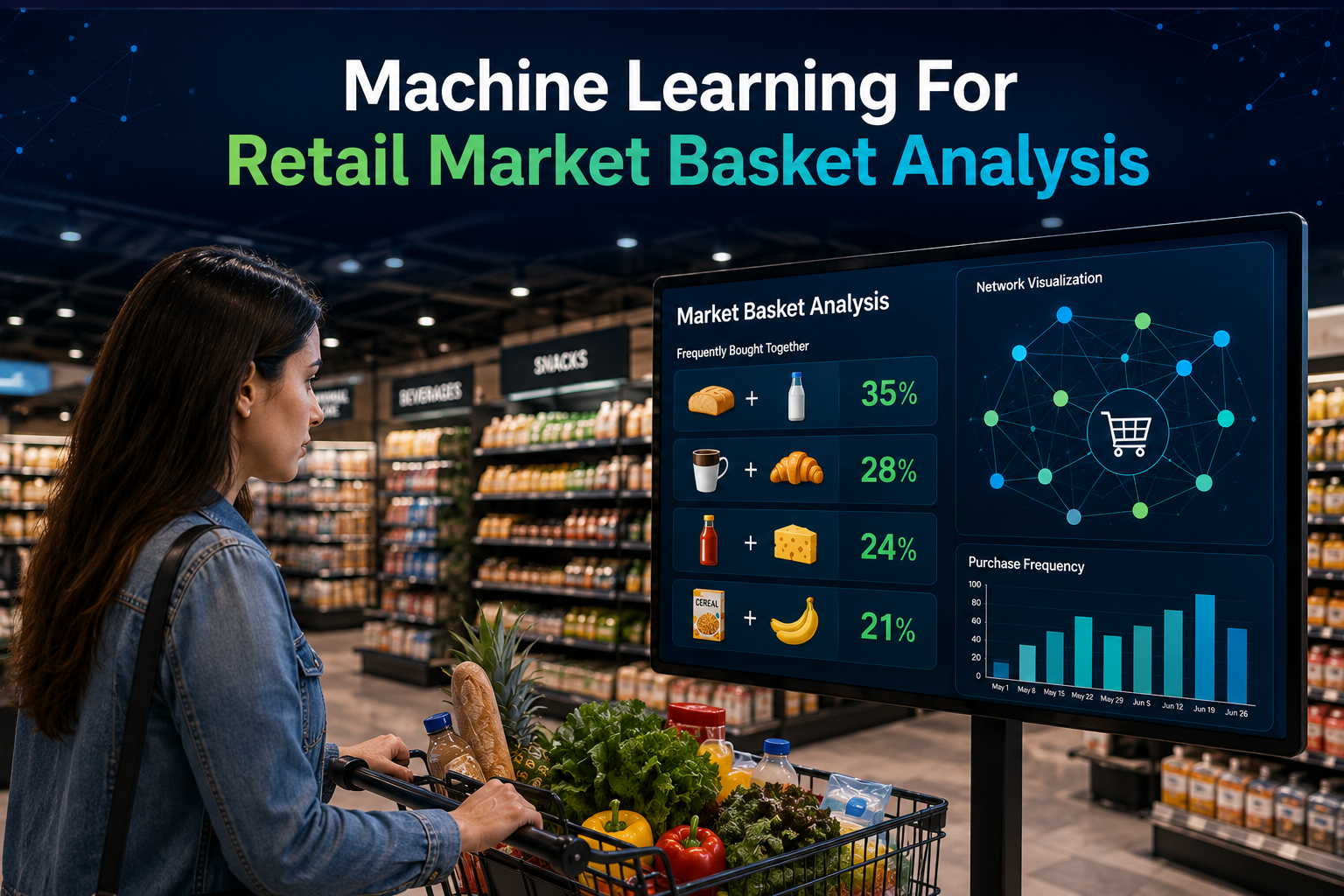
Retailers collect valuable information whenever customers browse products, add items to carts, or complete purchases. Hidden within those transactions are relationships that can reveal what shoppers naturally buy together. A customer purchasing coffee may also choose biscuits, while someone ordering a smartphone may add a protective case. Retail Market Basket Analysis helps businesses discover these connections and use them to improve merchandising and customer experiences. Machine learning extends this approach by examining larger datasets, customer behavior, seasonal changes, and product relationships that may be difficult to identify with simple rules.
Retail Market Basket Analysis
How Does Machine Learning Improve Basket Analysis?
Customer behavior changes over time, which makes static rules difficult to maintain. Machine learning can process large transaction datasets and identify patterns across different customer groups, periods, and product categories. Models can learn from historical purchases and recognize relationships that may change as preferences evolve. Instead of applying one recommendation strategy to everyone, retailers can use data-driven insights to make suggestions more relevant to individual shopping contexts.
Inventory Planning And Assortment Decisions
Product relationships can influence inventory decisions as well. When two items are frequently purchased together, a shortage of one may affect demand for the other. Retailers can use these connections when reviewing replenishment priorities and assortment plans. Basket analysis may also reveal complementary products that belong to different categories, helping businesses create assortments that reflect how customers actually shop.

Personalized Product Recommendations
Basket analysis can provide valuable signals for recommendation systems. When a shopper views or purchases an item, the retailer can suggest complementary products based on relationships found in previous transactions. Machine learning can improve these suggestions by considering customer history, product similarity, recent activity, and purchasing context. A shopper buying running shoes, for example, may receive recommendations for socks, fitness accessories, or shoe-care products rather than unrelated items.
Improving Cross-Selling Opportunities
Cross-selling becomes more useful when suggestions are based on genuine purchasing behavior. Instead of promoting random products, retailers can identify items that naturally fit together. An electronics business may recommend accessories for a device, while a home improvement retailer may suggest tools that match a selected material. Machine learning can rank potential additions using purchase patterns and customer preferences, making the experience more relevant and less intrusive.

Product Bundling And Promotions
Retailers can use basket insights to design bundles that provide practical value. If several products repeatedly appear in the same transactions, they may be offered as a convenient package or promoted together. Machine learning can identify strong relationships and show whether those combinations vary by customer group, season, or location. This allows promotional planning to rely more on observed behavior instead of assumptions.
Customer Segmentation And Basket Behavior
Different customer groups often have different purchasing habits. Some shoppers buy frequently at lower values, while others make occasional high-value purchases. Machine learning can combine basket relationships with customer segments to identify more specific patterns. A product combination may be especially common among loyal customers, new shoppers, or buyers in a particular category. These insights can support targeted campaigns and more relevant recommendations.

Using Real-Time Shopping Signals
Modern retail platforms collect signals while customers are actively shopping. Searches, product views, cart additions, and completed purchases provide context beyond historical transaction records. When used responsibly, these signals can help adjust recommendations during a current session. A shopper viewing several products from one category may receive related suggestions based on that immediate interest. Real-time analysis makes basket-based recommendations more responsive.
Data Quality And Feature Engineering
Reliable basket analysis begins with well-prepared transaction data. Retailers may need to standardize product identifiers, handle returns, remove duplicate records, and organize transactions into meaningful time periods. Additional features can include purchase frequency, recency, average order value, category preference, and customer tenure. Good feature engineering gives models more context and can make discovered relationships more useful for business decisions.

Measuring The Success Of Basket Analysis
Retailers should evaluate basket-analysis initiatives through both technical and commercial measures. Useful business indicators include recommendation click-through rate, conversion rate, average order value, bundle sales, cross-sell revenue, and customer engagement. Model evaluation can also test whether discovered relationships remain reliable on newer transactions. Comparing results against an existing recommendation method or baseline helps show whether machine learning is producing measurable improvement.
The Future Of Machine Learning In Basket Analysis
Market basket analysis is moving toward more dynamic systems that combine transaction history, customer behavior, product information, real-time activity, and contextual signals. Advanced models can help retailers understand not only which products are connected, but also when and for whom those relationships are most useful. This can support adaptive recommendations, smarter promotions, and stronger assortment planning. Human review will remain valuable because commercial teams need to confirm that discovered patterns make practical business sense.
Conclusion
Machine learning can turn transaction data into practical insights about how products are purchased together. By combining association patterns with customer behavior, seasonality, product information, and real-time signals, retailers can create more relevant recommendations and merchandising strategies. The strongest results depend on clean data, careful validation, clear business goals, and continuous measurement. Used thoughtfully, Retail Market Basket Analysis can help improve product discovery, strengthen cross-selling, support better bundles, and create a more useful shopping experience.