
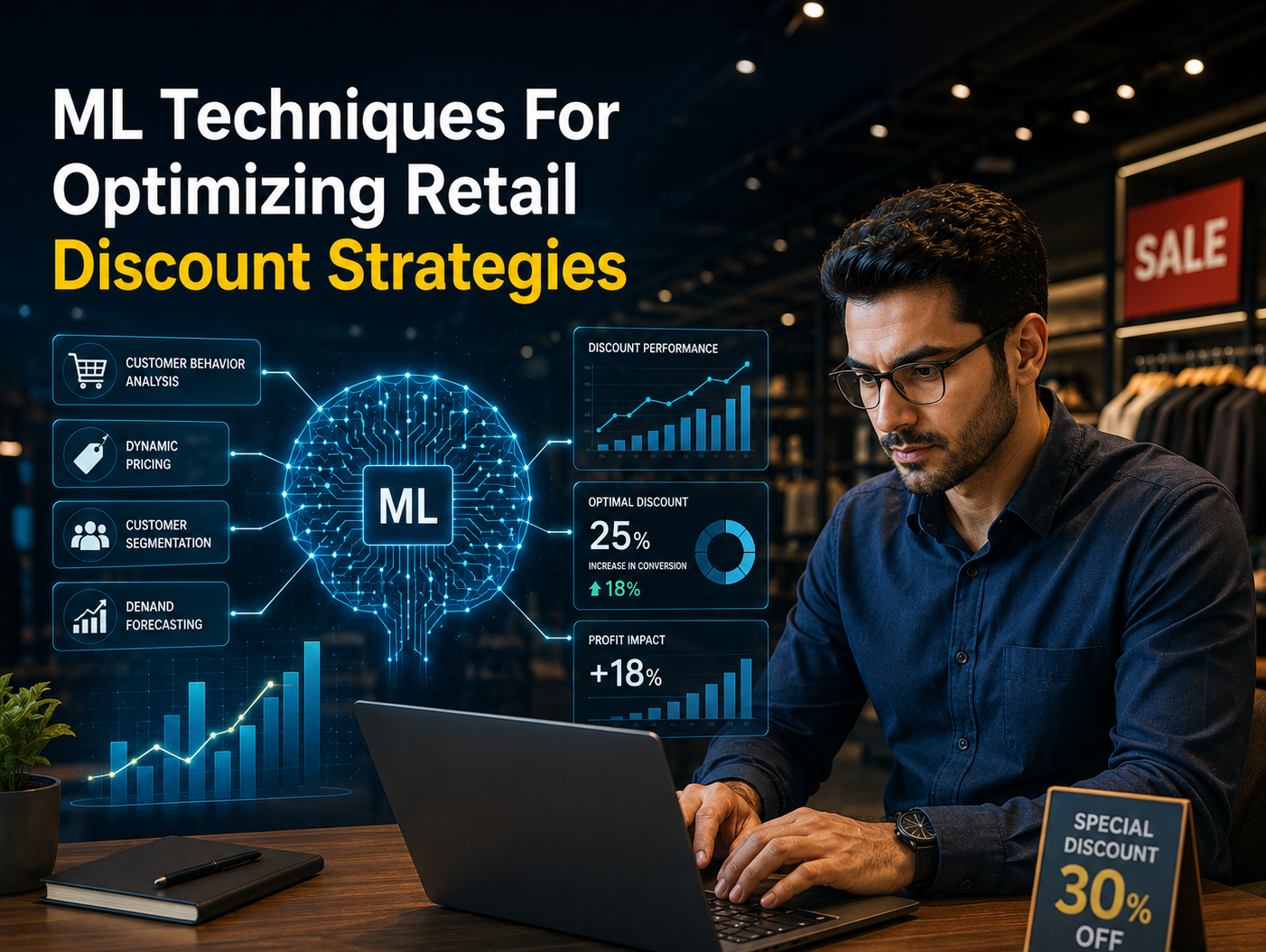
Discounts are a familiar part of retail, but choosing the right offer at the right time is more complicated than simply reducing a price. A promotion that attracts customers may also reduce profit if it is applied too broadly or to products that would have sold without an incentive. Retailers need to understand demand, customer behavior, inventory levels, product life cycles, and competitive conditions before deciding how much value to offer. Machine learning can help by examining these signals and identifying patterns that support more informed decisions. ML Retail Discount Strategies can help businesses balance sales growth, customer engagement, inventory movement, and profitability.
Retail Discount Strategies
How Does Machine Learning Support Discount Decisions?
Machine learning can analyze historical transactions, product attributes, customer activity, promotion records, inventory information, and other relevant signals. Models can estimate how demand may respond to different price points or promotional conditions. They can also identify groups of shoppers who are more likely to respond to a particular incentive. Instead of treating every product and customer in the same way, retailers can use these insights to create more targeted offers. The objective is not to discount everything, but to apply incentives where they have a measurable purpose.
Understanding Price Elasticity
Price elasticity describes how strongly demand changes when a product’s price changes. Some items are highly sensitive to price, while others maintain relatively stable demand even when discounts are small. Machine learning can estimate these differences by studying historical sales under varied pricing conditions. Retailers can use the resulting insights to determine where a discount may generate meaningful additional volume. Understanding elasticity is especially valuable because a lower price does not automatically lead to a proportionally higher number of purchases.
Demand Forecasting For Promotions
Before launching a promotion, retailers need a reasonable estimate of expected demand. Machine learning can combine historical sales with seasonality, holidays, product launches, marketing activity, and previous promotion results. This helps planners anticipate the likely effect of an offer and prepare inventory accordingly. A reliable forecast can reduce the risk of running out of stock during a successful campaign or carrying excess products after an unsuccessful one. Forecasting also provides a baseline for measuring whether the promotion delivered the expected uplift.
Personalizing Discounts
Customers do not respond to promotions in the same way. Some shoppers actively compare prices, while others prioritize convenience, brand preference, or product availability. Machine learning can segment customers according to purchasing behavior and estimate which types of offers may be relevant to each group. A retailer might provide a product-specific incentive to a price-sensitive shopper while offering a loyalty benefit to a frequent customer. Personalization can make promotions more useful while reducing unnecessary reductions for shoppers who were already likely to purchase.
Optimizing Discount Depth
The size of a discount matters. A small reduction may have little effect on demand, while a large cut can increase volume but weaken margins. Machine learning models can compare historical outcomes across different discount levels and estimate the likely response for similar products or customer groups. This allows retailers to explore a more suitable discount range instead of relying on a single standard percentage. The best offer is often the one that creates enough incremental demand to justify the reduction in price.
Inventory-Aware Discounting
Discount decisions should reflect the amount of stock available and the time remaining in a product’s selling cycle. A retailer with excess inventory may need a stronger incentive, while a fast-selling product may require little or no reduction. Machine learning can connect demand forecasts with inventory levels, replenishment schedules, and product age. This creates a more balanced approach in which discounts support both sales objectives and stock management. It can be particularly useful for seasonal merchandise and products approaching the end of their life cycle.

Reducing Excess Inventory
Slow-moving products can occupy valuable storage space and tie up working capital. A carefully designed promotion may help improve sell-through before products become obsolete or lose relevance. Machine learning can identify items with declining demand and estimate which promotional actions may encourage additional purchases. Rather than applying a broad markdown across an entire category, retailers can focus attention on specific products where intervention is most likely to help. This targeted approach can protect margin while addressing inventory pressure.
Competitive And Market Signals
Retail pricing does not operate in isolation. Competitor activity, category demand, market conditions, and changes in customer expectations can affect promotional performance. Where reliable external information is available, machine learning can incorporate these signals into forecasting and decision support. This can help retailers recognize when a discount is needed to remain competitive and when aggressive price reductions may be unnecessary. External signals should be evaluated carefully because noisy or delayed information can weaken predictions.

Protecting Profit Margins
Revenue growth alone does not determine whether a discount is successful. Retailers must consider product cost, promotional expenses, fulfillment costs, and the amount of additional demand created by the offer. Machine learning can help estimate expected contribution under different scenarios so decision-makers can compare volume gains with margin impact. This encourages retailers to evaluate promotions from a profitability perspective instead of measuring success only through units sold or total sales value.
Measuring Promotional Uplift
A promotion should be evaluated against what would have happened without the offer. Comparing actual results with that baseline provides a clearer picture of whether the discount generated additional purchases. This distinction is important because some customers may have purchased at the regular price, meaning their transactions should not automatically be counted as promotional gains.
Testing And Experimentation
Retailers should test discount ideas before rolling them out widely. Controlled experiments can compare different offer levels, customer groups, or promotional messages while measuring incremental results. Machine learning can help identify promising combinations and learn from previous tests. A structured experimentation process reduces the risk of making large decisions based on assumptions. It also creates a growing evidence base that can improve future promotional planning.
Data Quality And Model Reliability
Machine learning is only as useful as the information provided to it. Retailers should maintain accurate transaction records, product costs, promotion histories, inventory counts, and customer data. Incorrect pricing records or missing promotion details can lead to misleading conclusions. Models should also be monitored after deployment because customer behavior and market conditions can change. Regular validation helps identify performance issues before they affect major pricing decisions.
Conclusion
Machine learning can make Retail Discount Strategies more precise by helping businesses understand demand sensitivity, customer behavior, inventory pressure, promotional uplift, and margin impact. Instead of applying broad discounts based on fixed rules, retailers can use evidence to decide which products, shoppers, channels, and time periods deserve an incentive. The strongest results come from reliable data, careful experimentation, clear profitability measures, and human oversight. Used thoughtfully, ML can help retailers increase promotional effectiveness while protecting revenue quality and long-term customer value.