
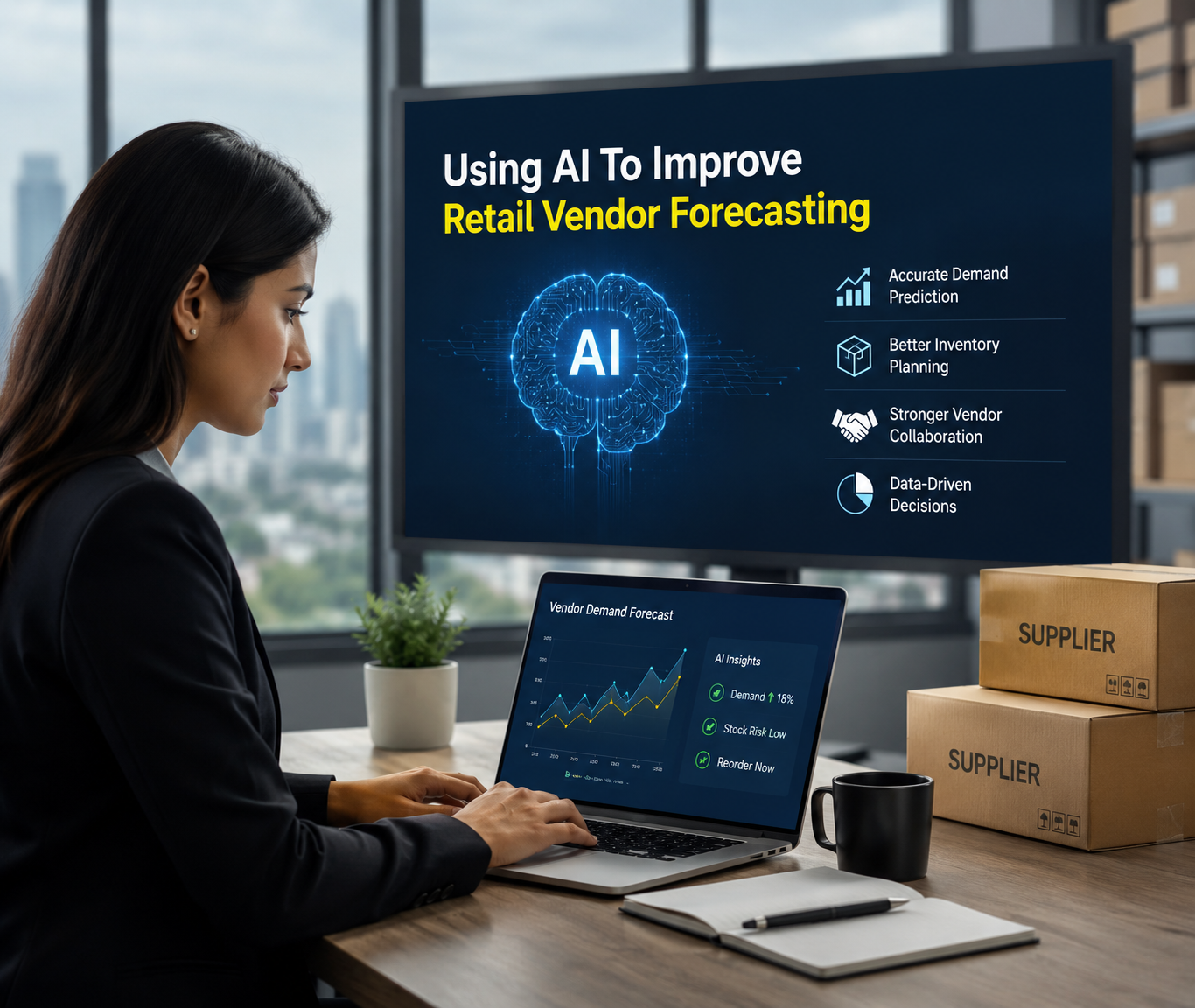
Retailers depend on reliable vendor relationships to maintain product availability, control purchasing costs, and meet changing customer expectations. However, fluctuating demand, seasonal patterns, supplier lead times, price changes, promotions, and unexpected market conditions can make vendor planning difficult. Traditional forecasting methods often rely heavily on historical reports and manual analysis, which may not provide enough insight for fast-moving retail environments. AI can help retailers examine sales records, supplier performance, inventory movement, purchasing behavior, and market signals to improve planning decisions. With Retail Vendor Forecasting, businesses can gain better visibility into future purchasing requirements, strengthen supplier coordination, reduce supply disruptions, and create a more responsive retail operation.
Retail Vendor Forecasting
Retailers Need AI-Based Vendor Forecasting
Retailers often manage hundreds or thousands of products across multiple vendors and locations. Each supplier may have different lead times, minimum order quantities, pricing structures, delivery schedules, and reliability levels. Manual forecasting becomes difficult when these factors interact with changing customer demand. AI can process large volumes of information quickly and identify patterns that teams may overlook during conventional analysis. Retailers can use these insights to improve purchase planning, reduce supply uncertainty, and coordinate vendor activity more effectively.
How AI Improves Vendor Forecasting ?
AI combines information from sales platforms, procurement systems, inventory databases, vendor records, e-commerce channels, and market sources to create a broader view of supply requirements. Machine learning models can analyze historical purchasing patterns and compare them with current demand signals. The system can identify changes in product movement, supplier performance, order frequency, and customer activity. Retail teams can use these insights to make purchasing decisions with greater confidence and respond more quickly when market conditions change.
Analyzing Historical Vendor Performance
Past vendor performance provides valuable information for future planning. AI can examine delivery times, order accuracy, product availability, purchase quantities, fulfillment consistency, and previous demand patterns. Retailers can use these insights to understand how different suppliers perform under varying conditions. This analysis can also help businesses identify vendors that consistently meet expectations and suppliers that require closer monitoring.
Forecasting Product Requirements
AI can estimate future product requirements by examining sales history, seasonal behavior, promotions, customer activity, inventory levels, and purchasing trends. Retailers can use these forecasts to determine how much stock they may need from each vendor. Accurate product-level forecasting helps businesses avoid unnecessary purchases while maintaining sufficient availability for expected demand.
Predicting Vendor Demand Changes
Vendor requirements can change when customer demand shifts unexpectedly. AI can monitor sales activity, product searches, promotional response, seasonal movements, and market signals to identify emerging changes. Retailers can use these insights to adjust vendor orders before demand changes create significant inventory pressure. Early detection can help businesses respond to opportunities while limiting unnecessary stock accumulation.
Reducing Stockouts
Stockouts can result in lost sales, customer dissatisfaction, and reduced brand trust. AI can compare projected demand with available inventory and expected supplier deliveries to identify potential shortages. Retail teams can use these alerts to review purchase orders, adjust replenishment schedules, or coordinate with vendors. This proactive approach can improve product availability and support a better customer experience.
Supporting Seasonal Vendor Planning
Seasonal events can create significant changes in product demand. Holidays, festivals, weather conditions, school seasons, and promotional periods can influence purchasing behavior. AI can analyze historical seasonal patterns and compare them with current market signals to estimate future requirements. Retailers can share these forecasts with vendors so suppliers can prepare production and delivery schedules in advance.
The Role of an AI Development Company
An experienced AI development company can help retailers build customized vendor forecasting solutions around their operational requirements. A technology partner can integrate procurement platforms, inventory systems, sales applications, supplier records, e-commerce channels, and analytical tools into a connected forecasting environment. The solution can include machine learning models, predictive dashboards, vendor performance analytics, automated alerts, and demand forecasting capabilities. A customized platform can help retailers improve purchasing decisions while giving supply chain teams clearer visibility into vendor activity.
Build and Test AI Forecasting Models
Retailers can select machine learning models according to their forecasting requirements and train them with historical purchasing and demand information. Teams should compare model predictions with actual outcomes and refine the system when performance does not meet business expectations.
Monitor and Improve Forecast Accuracy
Retailers should continuously compare forecasts with actual demand and vendor performance. Teams can update models with new information and adjust forecasting methods as customer behavior, supplier conditions, and market trends change. Continuous monitoring helps maintain useful and relevant vendor forecasts.
Challenges in Retail Vendor Forecasting
AI based forecasting requires accurate and consistent information. Poor supplier records, incomplete purchasing data, inconsistent product classifications, sudden demand changes, and unexpected supply disruptions can affect forecast quality. Retailers also need to establish clear data governance and review forecasting performance regularly. AI should support experienced purchasing and supply chain teams rather than replace human judgment. Combining intelligent predictions with practical vendor knowledge can produce stronger decisions.
Future of Retail Vendor Forecasting
The future of Retail Vendor Forecasting will increasingly combine predictive intelligence with real-time supply chain information. AI systems can connect customer demand, inventory levels, supplier performance, purchasing activity, market conditions, and delivery information to create a more dynamic view of future requirements. Advanced solutions may recommend purchase quantities, identify supplier risks, predict delivery delays, and suggest adjustments to replenishment plans. As retailers adopt these capabilities, vendor forecasting can become a continuous decision-support function rather than a periodic planning exercise.
Conclusion
AI can transform the way retailers plan vendor requirements, manage purchasing decisions, and coordinate supplier relationships. Through Retail Vendor Forecasting, businesses can analyze demand patterns, supplier performance, lead times, inventory conditions, seasonal changes, and purchasing activity to make more informed decisions. These capabilities can help retailers reduce stockouts, control excess inventory, improve purchase planning, manage costs, and strengthen collaboration with vendors. An experienced AI development company can help retailers create customized forecasting solutions that integrate with existing procurement and inventory systems. By combining reliable data, machine learning, real-time insights, and human expertise, retailers can build a more responsive vendor management strategy and support sustainable operational growth.