
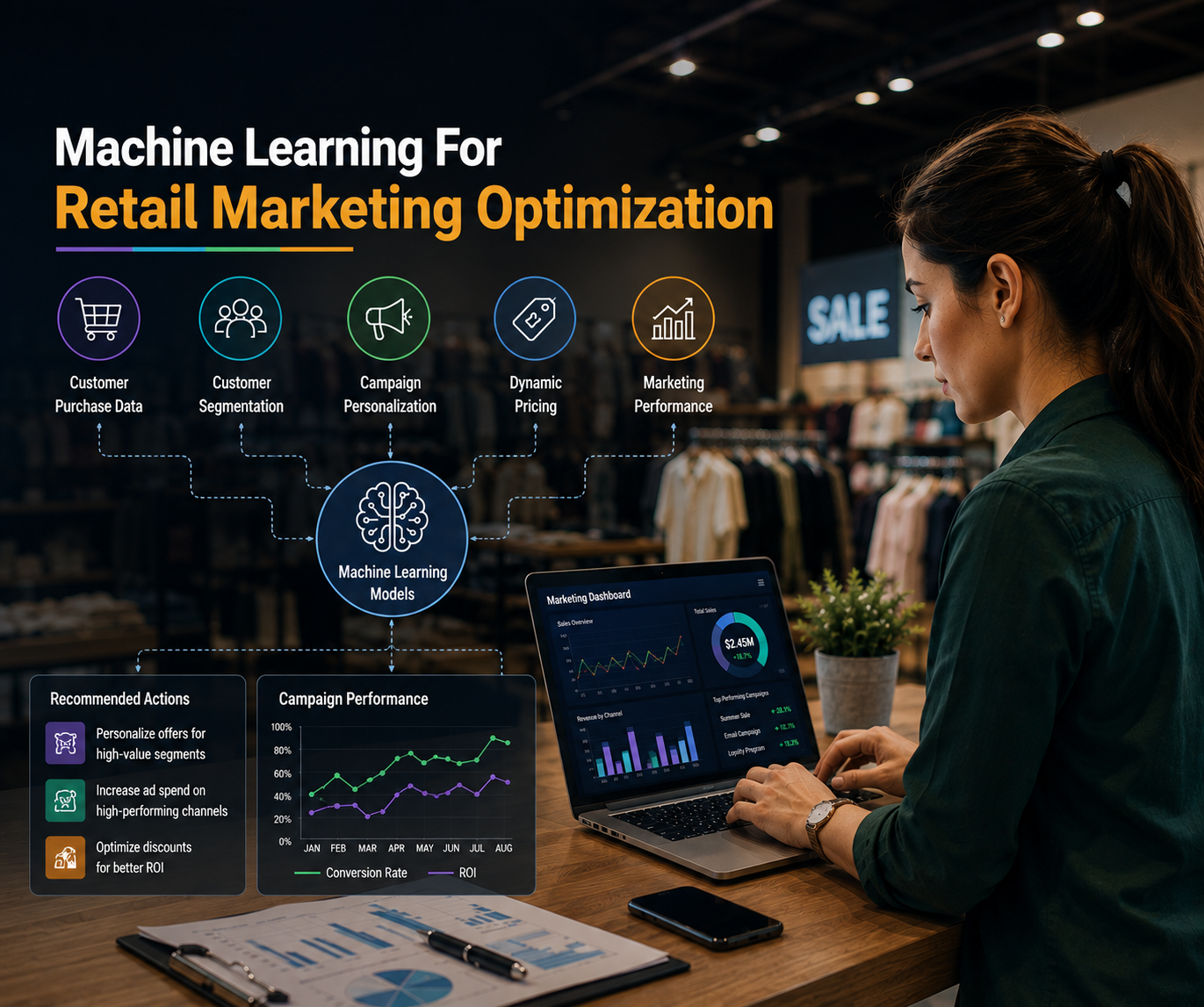
Retail marketing has become increasingly data-driven as customers interact with brands through stores, websites, mobile applications, social platforms, email, and marketplaces. Retailers need to understand these interactions to create relevant campaigns, allocate budgets effectively, and improve customer engagement. Traditional marketing analysis often relies on historical reports and manual interpretation, which can limit the speed and accuracy of decision-making. Machine learning can analyze customer behavior, campaign performance, purchasing patterns, product demand, pricing activity, and market signals to uncover valuable insights. Through Retail Marketing Optimization, businesses can improve audience targeting, personalize campaigns, evaluate marketing performance, and make better use of promotional resources.
Retail Marketing Optimization
Retailers Need ML for Marketing
Retailers operate in highly competitive markets where customer preferences can change quickly. Machine learning allows retailers to examine changing patterns and respond with greater precision. By analyzing current and historical information, businesses can identify valuable audiences, understand campaign behavior, forecast demand, and improve marketing decisions. This approach can reduce unnecessary spending while creating more meaningful customer interactions.
How ML Improves Retail Marketing?
Machine learning can analyze information from customer transactions, websites, loyalty programs, marketing platforms, inventory systems, and sales channels. Models can identify patterns in customer engagement, product preferences, purchase frequency, campaign response, and conversion behavior. Retailers can use these insights to improve targeting, content selection, promotional timing, product recommendations, and budget allocation. Continuous analysis also helps marketing teams adjust their strategies as customer behavior changes.
Customer Segmentation
Customer segmentation helps retailers understand groups with similar characteristics or behaviors. Machine learning can analyze purchase history, browsing activity, order value, product preferences, engagement levels, and shopping frequency to identify meaningful customer segments. Retailers can then create marketing strategies that match the interests and needs of each group. More relevant segmentation can improve campaign engagement and reduce the use of broad messages that may not appeal to every shopper.
Personalized Marketing Campaigns
Customers respond differently to products, offers, communication channels, and promotional messages. Machine learning can analyze individual behavior to determine which products, and content may interest specific shoppers. Retailers can use these insights to personalize email campaigns, website recommendations, mobile messages, and promotional offers. Personalized communication can make marketing more relevant and encourage customers to interact with the brand.
Optimizing Marketing Budgets
Marketing budgets require careful allocation across different channels and campaigns. Machine learning can analyze historical spending and business outcomes to identify patterns between marketing investment and performance. Retailers can use these insights to determine where additional resources may create stronger results. Data-driven budget allocation can help businesses improve efficiency while maintaining flexibility for changing market conditions.
Improving Customer Acquisition
Acquiring new customers can involve significant advertising and promotional costs. Machine learning can help retailers identify audiences that show characteristics associated with valuable customers. Businesses can analyze demographics, purchasing behavior, engagement patterns, and acquisition sources to improve targeting. This approach can help retailers focus acquisition efforts on audiences that have stronger potential for long-term engagement.
Product Recommendation Optimization
Product recommendations can influence customer engagement and sales. Machine learning models can analyze previous purchases, browsing behavior, product relationships, and customer preferences to identify relevant products. Retailers can display recommendations across websites, applications, emails, and other channels. Relevant suggestions can improve the shopping experience while creating additional opportunities for cross-selling and repeat purchases.
Optimizing Marketing Timing
Machine learning can examine purchasing patterns, engagement history, behavior, and previous campaign performance to identify suitable periods for marketing activity. Retailers can use these insights to send messages and launch promotions when customers are more likely to respond. Better timing can improve engagement without requiring larger marketing budgets.
Real-Time Optimization
Customer behavior can change quickly, especially during major promotions, seasonal events, and product launches. Machine learning can process new information and identify changes in campaign performance as they occur. Retailers can use these insights to adjust targeting, messaging, promotional activity, and budget allocation during an active campaign. Real-time optimization can help businesses respond quickly to opportunities and underperforming strategies.

Role
Collect and Prepare Marketing Data
Businesses should gather customer transactions, campaign results, website activity, loyalty information, product interactions, marketing costs, and relevant sales information. Teams should clean the data, address missing values, remove duplicate records, and maintain consistent customer and product classifications.
Select Suitable Machine Learning Models
Retailers should choose models based on their marketing requirements. Classification models can support customer segmentation, clustering can identify similar audiences, predictive models can estimate customer behavior, and recommendation systems can improve product suggestions. The right model can improve the quality and relevance of marketing insights.
Connect Insights With Marketing Platforms
Retailers should integrate machine learning outputs with marketing systems, customer relationship platforms, e-commerce applications, and campaign management tools. This connection allows marketing teams to use insights directly within their existing workflows.
Conclusion
Machine learning provides retailers with powerful capabilities for improving marketing decisions, understanding customer behavior, and creating more relevant experiences. An experienced AI development company can help retailers build customized solutions that connect machine learning with their existing marketing and retail systems. By combining reliable data, intelligent models, continuous measurement, and human expertise, retailers can create more efficient marketing strategies, improve customer engagement, and support sustainable business growth.