
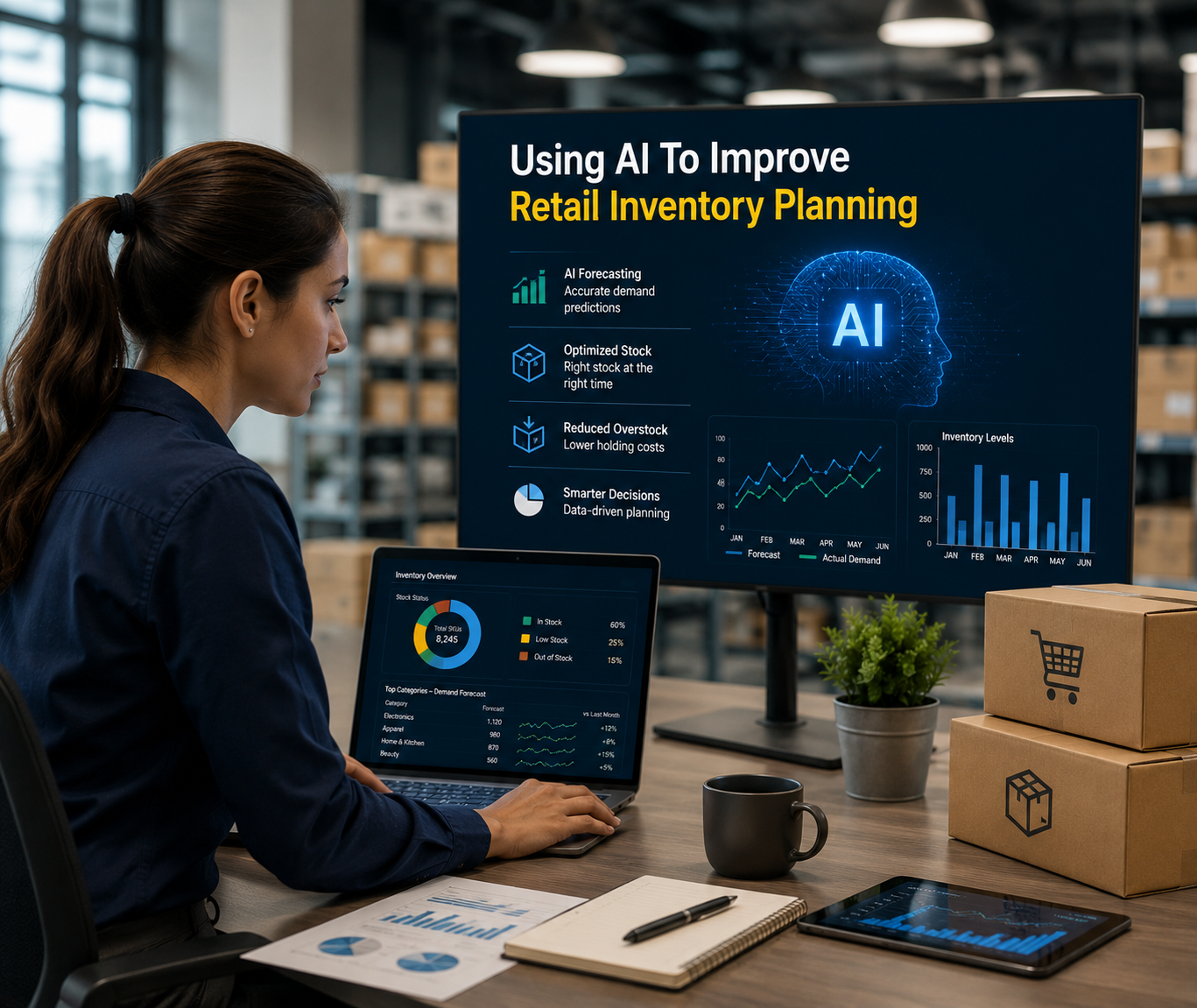
Retailers need the right products in the right locations at the right time to meet customer expectations and control inventory costs. Traditional planning methods often depend heavily on historical reports and manual decisions, which may not provide enough insight when demand changes quickly. Artificial intelligence can analyze sales records, inventory levels, customer behavior, supplier information, pricing activity, and market signals to support more accurate planning. Through Retail Inventory Planning, businesses can improve stock availability, reduce excess inventory, strengthen replenishment decisions, and respond faster to changing market conditions.
Retail Inventory Planning
Understanding Inventory Challenges
Businesses need to consider demand patterns, product life cycles, store-level requirements, supplier lead times, warehouse capacity, and customer preferences. Poor planning can create stockouts, excess inventory, markdowns, and unnecessary storage expenses. AI can examine these factors together and provide retailers with deeper insights into inventory requirements.
Improving Demand Inventory Decisions
Customer demand can vary across products, stores, regions, and sales channels. AI can analyze these differences and identify changing purchasing patterns. Retailers can use the resulting insights to adjust inventory quantities according to actual demand conditions. This approach can help businesses avoid applying the same inventory strategy to every product or location.
Balancing Stock Availability & Inventory Costs
Retailers need to maintain sufficient stock without investing unnecessarily in slow-moving products. AI can compare expected demand with available inventory, incoming shipments, and purchasing requirements to identify potential imbalances. Businesses can use these insights to maintain appropriate stock levels while reducing the financial impact of excess merchandise.
Detecting Inventory Imbalances Early
Inventory problems can develop gradually before they become visible through traditional reports. AI can monitor stock movement and identify unusual changes in product demand, inventory accumulation, or declining sales. Retail teams can investigate these signals and take corrective action before excess stock or product shortages create larger operational problems.
Improving Inventory Visibility
Accurate inventory information helps retailers understand what stock they have, where it sits, and how quickly it moves. AI can connect information from stores, warehouses, e-commerce platforms, and other sales channels to create a clearer inventory view. Better visibility can help teams identify stock differences, improve allocation, and make faster planning decisions.
Connecting Inventory With Customer Behavior
Customer behavior provides valuable signals for inventory planning. AI can analyze browsing activity, purchase history, product searches, cart activity, and customer preferences to identify potential changes in product interest. Retailers can combine these insights with inventory information to prepare for emerging demand and improve product availability.
Pricing Insights
Pricing decisions can influence inventory movement. AI can analyze historical prices, discounts, sales performance, and customer responses to understand how pricing changes affect product demand. Retailers can use these insights when deciding whether to maintain, reduce, or adjust inventory for particular products.

Connecting AI Insights With Retail Operations
AI creates greater value when inventory insights connect directly with purchasing, merchandising, warehouse, and supply chain activities. Purchasing teams can use demand signals to adjust orders, warehouse teams can improve allocation, and merchandising teams can review product movement. Connecting these insights with daily operations allows retailers to turn inventory predictions into practical decisions.
Inventory Planning Performance
Retailers can evaluate inventory planning through stock availability, inventory turnover, stockout frequency, excess inventory, carrying costs, replenishment efficiency, and sales performance. Regular performance reviews can help businesses determine whether AI improves planning quality and operational efficiency.
Conclusion
AI provides retailers with a practical way to improve inventory planning and respond to changing market conditions. An experienced ai development company can help retailers develop customized solutions that connect intelligent forecasting with existing inventory and supply chain systems. By combining reliable data, machine learning capabilities, continuous monitoring, and human decision-making, retailers can maintain better product availability, reduce unnecessary inventory costs, and build a more efficient planning strategy.