
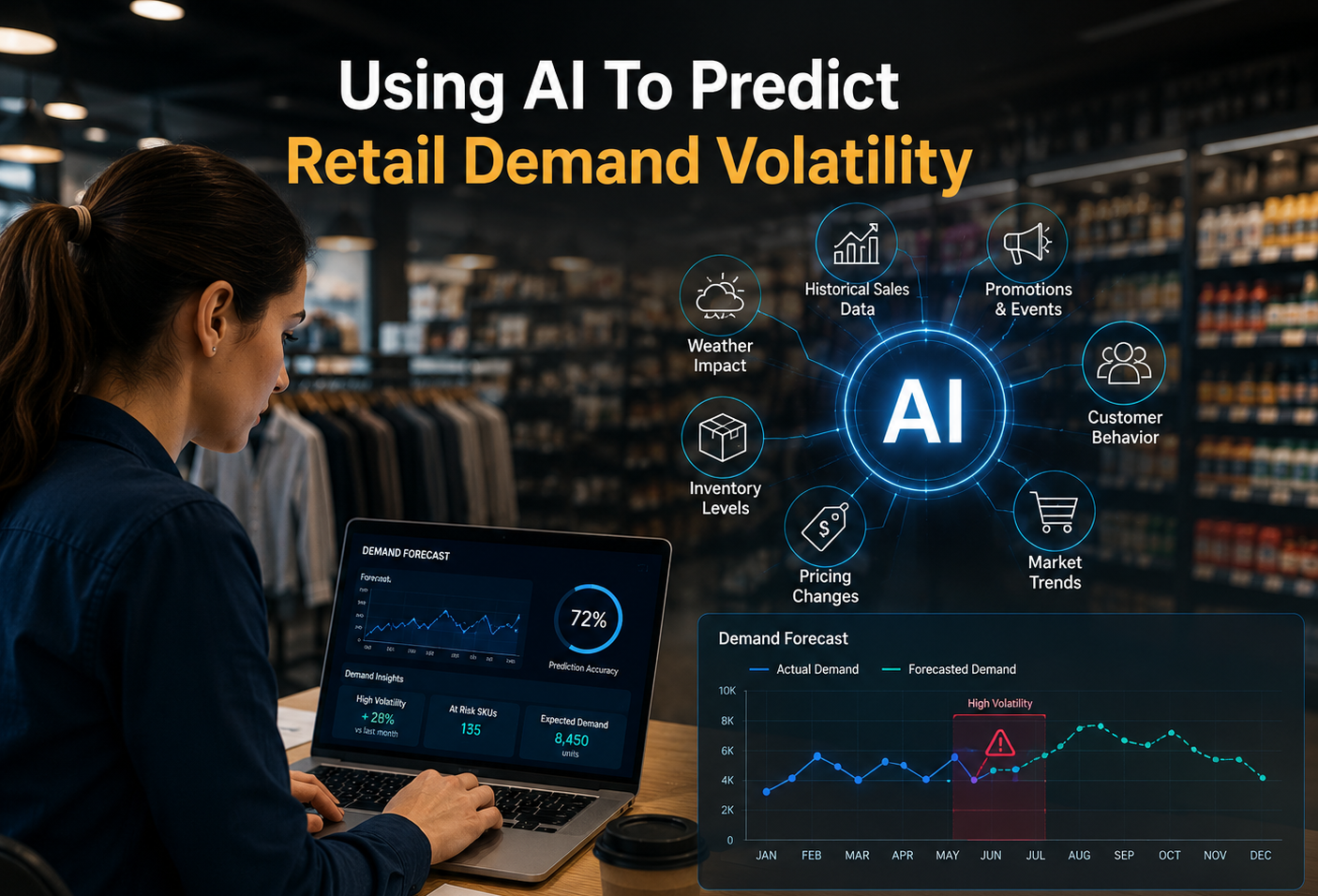
Retail demand can change rapidly because of seasonal trends, promotions, customer preferences, economic conditions, competitor activity, weather, and unexpected market events. These fluctuations make it difficult for retailers to determine how much merchandise they will need and when demand is likely to increase or decline. Traditional forecasting methods often depend heavily on historical patterns, which may not fully reflect sudden changes in consumer behavior. Artificial intelligence can analyze a wider range of signals and identify emerging patterns before they significantly affect sales. By using AI to predict Retail Demand Volatility, businesses can improve planning, manage inventory more effectively, reduce unnecessary costs, and respond faster to changing market conditions.
AI To Predict Retail Demand
Predicting Demand Volatility Matters
Accurate demand planning affects purchasing, inventory, warehousing, staffing, distribution, and customer service. When demand is underestimated, retailers may experience stock shortages and missed sales. When expected demand is too high, businesses can accumulate excess merchandise, increase storage expenses, and rely on discounts to clear unwanted stock. Predicting volatility gives retailers a better understanding of where demand may change and how strongly it could move, helping decision-makers balance product availability with financial efficiency.
How AI Predicts Retail Demand Volatility?
AI can examine historical sales alongside real-time and external signals to identify patterns associated with changing demand. Machine learning models can evaluate product performance, customer behavior, promotional activity, seasonal trends, pricing changes, online engagement, and other relevant information. Intelligent systems can identify possible changes in demand and estimate different outcomes, allowing retailers to prepare for uncertainty rather than relying on a single forecast that may not reflect current conditions.

Analyzing Historical Sales Patterns
Historical information provides a foundation for understanding how products have been performed over time. AI can examine previous sales cycles, seasonal peaks, promotional periods, regional differences, and product-level behavior to identify recurring patterns. Advanced models can distinguish normal fluctuations from unusual changes, giving retailers a stronger starting point for forecasting while reducing dependence on simple averages or manually created assumptions.
Real-Time Market Signals
Historical information alone may not be enough when customer behavior changes quickly. AI can incorporate current signals such as website activity, search behavior, product views, order trends, promotional responses, and other available indicators. When these signals begin to shift, models can detect changes that may indicate an upcoming increase or decrease in demand. Faster recognition gives retailers more time to adjust purchasing, inventory allocation, marketing activity, and fulfillment plans.

Detecting Sudden Demand Shifts
Some changes cannot be explained by normal seasonal behavior. A product may suddenly become popular because of a social media trend, influencer recommendation, viral content, competitor shortage, or unexpected event. AI can monitor sales and engagement patterns to identify unusual movements quickly. When demand begins to deviate from expected behavior, retailers can investigate the cause and determine whether additional inventory or operational adjustments are necessary.
Improving Inventory Planning
Demand volatility directly affects inventory decisions. Retailers need enough merchandise to satisfy customers without purchasing excessive quantities that may remain unsold. AI can combine demand forecasts with current stock, supplier lead times, replenishment schedules, and product movement to support informed inventory planning. This can help businesses adjust order quantities and timing according to changing conditions rather than following rigid replenishment rules.
Reducing Stockouts and Excess Inventory
Volatile demand creates a difficult balance between availability and overstocking. A sudden increase can result in stockouts, while an unexpected decline can leave businesses with surplus merchandise. AI can provide early indications of these risks by comparing expected demand with available inventory. Retailers can use these insights to accelerate replenishment, redirect stock, modify purchasing plans, or adjust promotions, supporting better inventory control while reducing financial exposure.
Pricing and Promotion Decisions
Promotions can create significant changes in customer demand, making accurate forecasting more difficult. AI can study previous campaign performance, price changes, customer responses, product availability, and sales outcomes to estimate how future promotions may influence demand. These insights can help retailers determine suitable promotional quantities and timing, reducing the risk of campaigns that create shortages or leave excess stock afterward.

Improving Workforce Planning
Changes in customer demand can influence staffing requirements, particularly in physical stores and fulfillment operations. Higher sales volumes may require additional employees for customer service, inventory handling, picking, packing, and checkout activities. AI can connect demand forecasts with workforce planning to help managers anticipate periods of increased activity. This can reduce understaffing during busy periods while limiting unnecessary labor allocation when demand is expected to be lower.
AI and Customer Behavior Analysis
Customer behavior provides valuable signals for understanding demand changes. AI can analyze browsing activity, purchase history, product searches, cart behavior, repeat orders, and engagement patterns to identify shifts in customer interest. These insights can help retailers recognize early signs of changing preferences. When combined with sales and market information, behavioral analysis can make demand forecasts more responsive and useful for planning.
Challenges
AI demand prediction can be affected by poor data quality, sudden market disruptions, limited historical information, changing customer behavior, and disconnected business systems. Retailers should combine AI predictions with business knowledge and continuously monitor performance. Clear data governance, reliable integration, and human oversight are important for maintaining useful forecasting results.
Success of AI Demand Prediction
Retailers should evaluate AI forecasting through practical business outcomes. Forecast accuracy, stockout frequency, excess inventory turnover, fulfillment performance, purchasing efficiency, and promotional results can provide useful indicators. Comparing these measures with previous forecasting methods can show whether AI is creating measurable improvements. Regular evaluation also helps businesses identify products or markets where models require additional data or refinement.
Future of Retail Demand
The future of Retail Demand Volatility prediction will increasingly involve real-time intelligence and adaptive forecasting. AI systems can continuously evaluate new sales activity, customer signals, market conditions, and operational information instead of relying on forecasts created at fixed intervals. As these systems become more advanced, retailers may receive earlier warnings about potential demand changes and automated recommendations for inventory, purchasing, pricing, and distribution decisions. This can create a more flexible retail environment where planning responds continuously to changing customer behavior.
Conclusion
Retail demand can change quickly, making traditional forecasting approaches difficult to maintain in uncertain conditions. With support from an experienced AI development company, retailers can develop customized forecasting capabilities that align with their operational needs. A well-designed AI strategy can turn demand uncertainty into actionable intelligence and help retailers make faster, more confident decisions in a constantly changing market.