
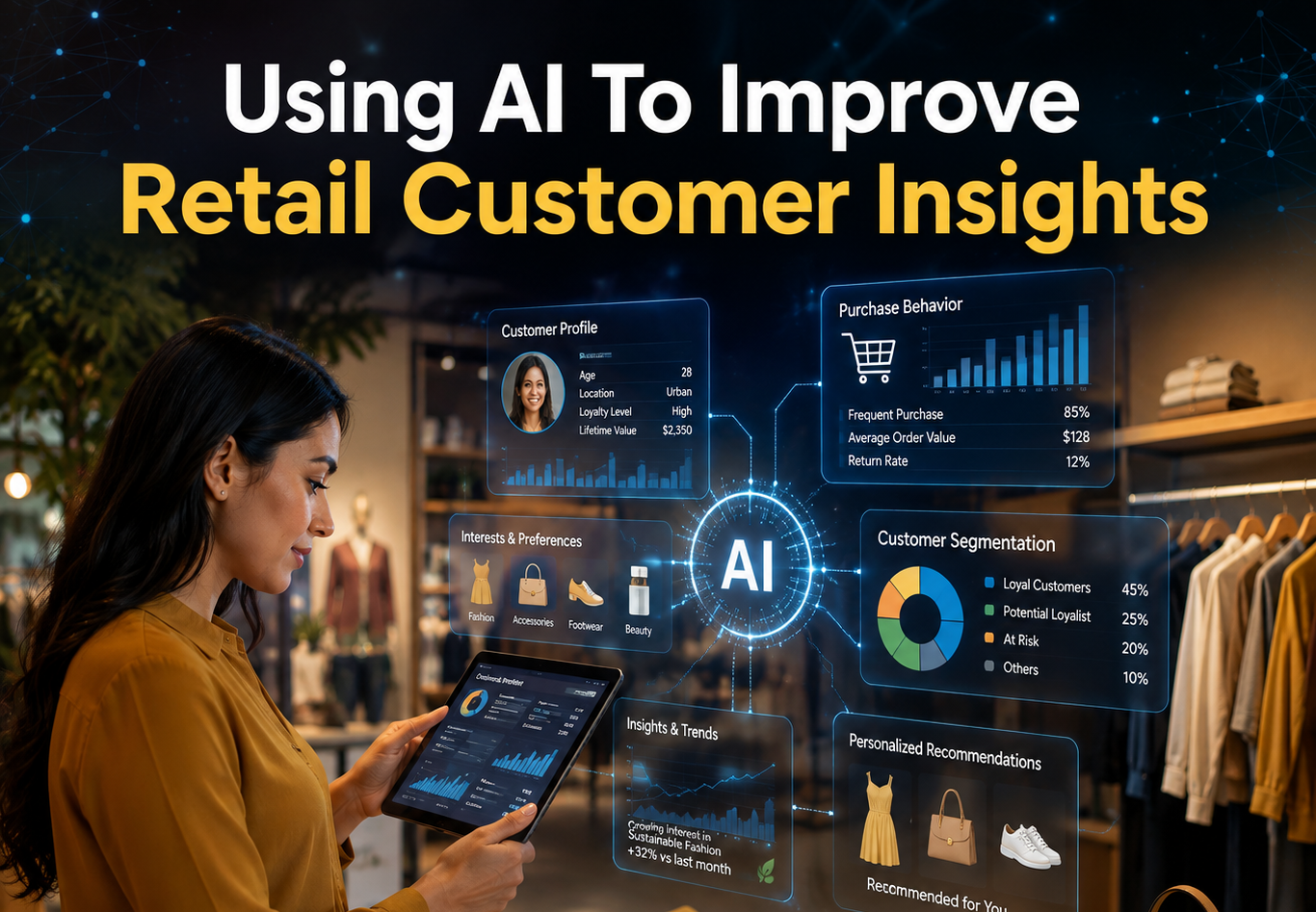
Retailers collect information from purchases, searches, loyalty activity, product reviews, service conversations, website visits, and store interactions. Artificial intelligence can help businesses interpret complex behavior, recognize patterns, and uncover preferences that may remain hidden inside disconnected datasets. With a thoughtful approach, Retail Customer Insights can become more timely, precise, and actionable. Instead of relying only on periodic reports, teams can use AI to understand changing expectations and make stronger decisions across products, marketing, merchandising, service, and customer experience.
Retail Customer Insights
How Does AI Transform Customer Analysis?
Unified Customer Data
AI performs best when retailers create a consistent view of customer information across channels. Connecting these sources can reduce fragmented analysis and reveal a broader customer journey. Retailers should establish clear identity rules, data definitions, consent practices, and access controls before combining records. A unified foundation does not mean collecting every possible detail. It means using relevant information responsibly to answer meaningful business questions.
AI Customer Segmentation
Customer segmentation helps retailers understand groups with different behaviors and needs. Clustering techniques can reveal groups that were not defined in advance. Predictive models can also estimate which customers may respond to particular actions. Segments should remain practical and interpretable so marketing and merchandising teams can translate analytical findings into useful experiences.
Predicting Customer Needs
Predictive analytics can help retailers estimate what customers may want next. Models can consider recent purchases, browsing behavior, product relationships, replenishment cycles, and engagement patterns. Predictions can support relevant recommendations, replenishment reminders, targeted offers, and service interventions without overwhelming customers. Retailers should also monitor prediction quality over time because customer interests can change quickly.
Churn Prediction And Retention
Customer retention often depends on recognizing declining engagement before a shopper becomes inactive. A churn model can assign probability rather than making a simple yes-or-no judgment. Retailers can use those signals to decide whether a helpful intervention makes sense, such as a relevant reminder, service recovery, or personalized offer. Retention programs should focus on customer value and experience rather than sending repeated discounts to everyone who shows lower activity.

Personalization With AI
AI can select products, content, offers, or communication timing based on individual and group behavior. Recommendation models can rank items according to predicted interest, while contextual systems can adjust suggestions according to channel or current activity. Excessive targeting can feel intrusive, so businesses need clear boundaries, transparent practices, and sensible frequency controls.
Real-Time Customer Signals
Customer behavior can change rapidly after a product launch, promotion, service issue, or external event. Real-time analysis can help teams respond while an issue is still developing. However, rapid detection should not trigger automatic action for every fluctuation. Appropriate thresholds and validation steps can prevent teams from reacting to temporary noise. The goal is timely awareness combined with disciplined decision-making.

Customer Insights For Merchandising
Merchandising teams need to understand which products attract attention, which combinations perform well, and where demand differs by location or channel. AI can connect customer behavior with product attributes, price points, seasonal conditions, and purchasing patterns. Localized insight is particularly valuable because a product that appeals strongly in one market may perform differently elsewhere. Retailers can use these signals to create assortments that better reflect actual customer needs.
Data Quality And Integration
Retailers should establish data-quality checks, shared definitions, reliable pipelines, and clear ownership. Identity resolution requires particular care because incorrect matching can combine information from different people or separate one person into multiple profiles. Strong governance creates more dependable insight and makes it easier for teams to understand where a finding came from.

Privacy & Responsible AI
Customer insight programs require responsible handling of personal information. Retailers should collect only relevant data, maintain clear consent practices, protect sensitive records, and restrict access according to legitimate business needs. AI models should also undergo regular review for unfair outcomes, unexpected bias, and inappropriate use. Transparent practices help build trust, reduce risk, and create a sustainable foundation for long-term personalization and analytics.
Building An AI Customer Insight Strategy
Retailers should identify which decisions would improve if customer behavior became easier to understand. Business users should participate throughout development because they understand operational context and practical constraints. A phased rollout can reduce risk while creating reusable capabilities. Over time, the insight function can evolve from reporting historical behavior toward anticipating customer needs.

Conclusion
Retail Customer Insights become more valuable when businesses connect accurate data with predictive models, natural language analysis, responsible personalization, and practical workflows. The goal is not to automate every customer decision. It is to help teams understand people more clearly and respond with greater relevance. Retailers that combine analytical intelligence with transparency and human judgment can build stronger relationships while creating measurable commercial value.