
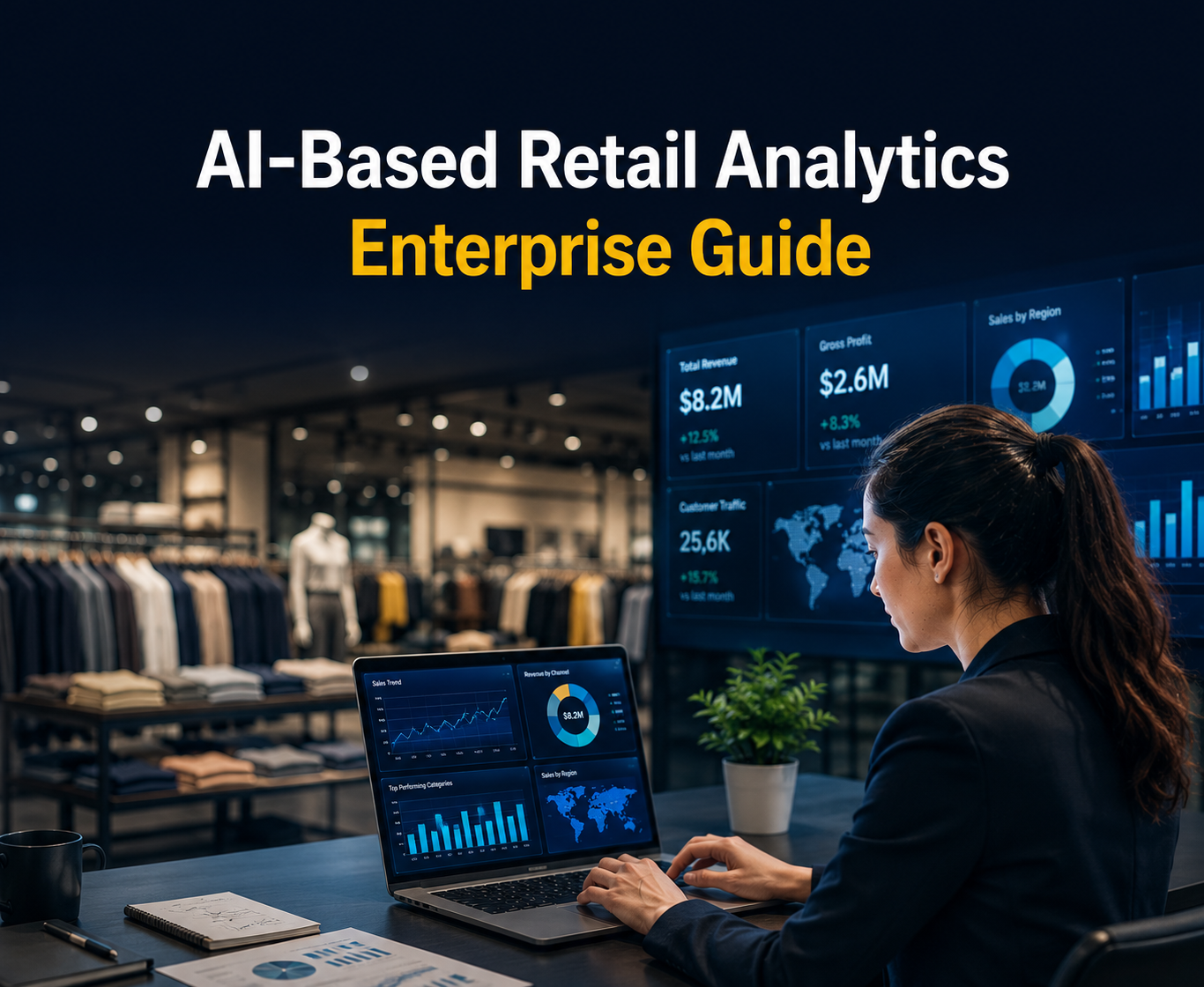
Retail businesses collect large amounts of information from stores, websites, mobile apps, point-of-sale systems, inventory platforms, customer programs, and marketing channels. However, raw data alone does not improve business performance. Retailers need clear insights that help them understand customers, predict demand, control inventory, improve pricing, and strengthen daily operations. AI retail analytics helps businesses turn complex data into useful insights through machine learning, predictive analysis, pattern recognition, and intelligent automation. As a result, enterprises can make faster decisions, identify emerging opportunities, and respond to changing customer needs with greater confidence.
AI Retail Analytics
AI Retail Analytics
AI retail analytics uses artificial intelligence to examine retail data and identify useful patterns. Unlike traditional reports that mainly describe past performance, AI can also help retailers understand current conditions and predict possible future outcomes. For example, a retailer can analyze sales activity, customer behavior, inventory movement, pricing, and promotions together. This connected view gives management teams better information for planning and decision-making.

Connecting Different Retail Data Sources
Retailers often store information across several systems. Sales platforms, customer databases, inventory applications, e-commerce websites, and marketing tools may operate separately. AI analytics can bring relevant information together and create a broader view of business performance. Therefore, teams can examine relationships between sales, customers, inventory, and marketing activity more effectively.
Turning Data Into Useful Insights
Large datasets can contain valuable patterns that manual analysis may miss. AI models can examine this information and identify changes in customer behavior, product demand, and operational performance. Consequently, retailers can focus their attention on important business signals instead of spending excessive time reviewing raw data.
Customer and Marketing Analytics
Customer information can reveal shopping preferences, purchase frequency, engagement patterns, and product interests. AI can organize this information into meaningful groups and identify behavioral trends. Marketing teams can then create more relevant campaigns and improve customer engagement. Personalized recommendations and targeted offers can also support cross-selling and upselling opportunities.
Improving Retail Decision-Making
Retail decisions often involve several connected factors. Customer demand can influence inventory, pricing can affect sales, and promotions can change purchasing patterns. AI analytics helps businesses examine these relationships and make decisions with better information.
Building an Enterprise AI Foundation
Successful retail analytics requires more than choosing an AI model. Businesses also need reliable data, suitable technology, clear processes, and responsible governance. A strong foundation allows AI systems to produce more consistent and useful results.
Data Quality and Governance
Accurate data plays a major role in retail analytics. Duplicate records, missing information, incorrect product details, and inconsistent inventory figures can reduce analytical quality. Retailers should maintain clear data standards and regularly review information quality. Strong governance also helps businesses manage access, security, and customer privacy.

Demand and Inventory Intelligence
AI can analyze sales history, current inventory, seasonal patterns, promotions, and customer activity to estimate future product requirements. Retailers can use these insights to improve purchasing and replenishment decisions. Moreover, businesses can identify products that may face shortages or accumulate excess stock. AI inventory planning can help retailers maintain suitable stock levels while responding to changing demand.
System Integration and Scalability
AI analytics should work with the systems that retail teams already use. Businesses can connect AI solutions with POS platforms, ERP systems, customer relationship tools, e-commerce applications, inventory software, and warehouse platforms. Furthermore, scalable architecture allows retailers to expand analytical capabilities as data volumes and business requirements grow.
Supporting Enterprise Growth With AI
Retail enterprises can use AI analytics to identify growth opportunities while improving operational efficiency. Predictive insights can help businesses understand which products may gain demand, which customer groups may respond to specific offers, and which locations may need inventory adjustments. In addition, intelligent analytics can help management teams compare performance across channels and identify areas that require attention.
Choosing an AI Development Company
An experienced ai development company can help retailers design customized analytics solutions based on their business requirements. A technology partner can connect data sources, develop machine learning models, build intelligent dashboards, integrate AI with existing applications, and monitor system performance. Moreover, customized development can help enterprises address specific retail challenges instead of relying entirely on generic analytics tools.

The Value of Retail Analytics
Retailers should measure AI performance through practical business outcomes. Useful indicators can include sales growth, inventory turnover, stock availability, forecast accuracy, customer engagement, campaign performance, operating costs, and margin contribution. Regular measurement helps businesses understand whether AI supports their goals. AI the same time, performance reviews can reveal opportunities to improve models, data quality, and workflows.
Practical AI Adoption Strategy
Retailers should begin with business problems that have clear objectives and measurable outcomes. A focused project can help teams understand how AI performs within their existing environment before they expand the technology across additional functions. Gradually, businesses can connect demand forecasting, inventory analytics, customer intelligence, pricing, promotions, and operational monitoring. This approach can reduce implementation complexity and create a clearer path toward enterprise adoption.
Future of Enterprise Retail Analytics
AI retail analytics will continue to evolve as businesses gain access to richer data and more advanced technologies. Predictive models can help retailers anticipate demand, while recommendation systems can support personalization and optimization tools can improve operational decisions. Generative AI can also help teams interact with business information through natural language. Meanwhile, organizations need adaptable processes and clear accountability to gain lasting value from AI. Recent research suggests that AI investment alone does not guarantee broader business resilience when companies keep outdated structures and rigid processes.
Conclusion
AI retail analytics helps enterprises transform complex retail data into practical business intelligence. Retailers can use these capabilities to improve demand forecasting, inventory planning, customer understanding, marketing performance, pricing, store operations, and supply chain decisions. An experienced ai development company can support this transformation by building customized solutions that connect AI with existing retail systems. By combining reliable data, clear objectives, strong governance, and continuous performance measurement, retailers can create a smarter analytical environment, respond faster to market changes, and support sustainable business growth.