
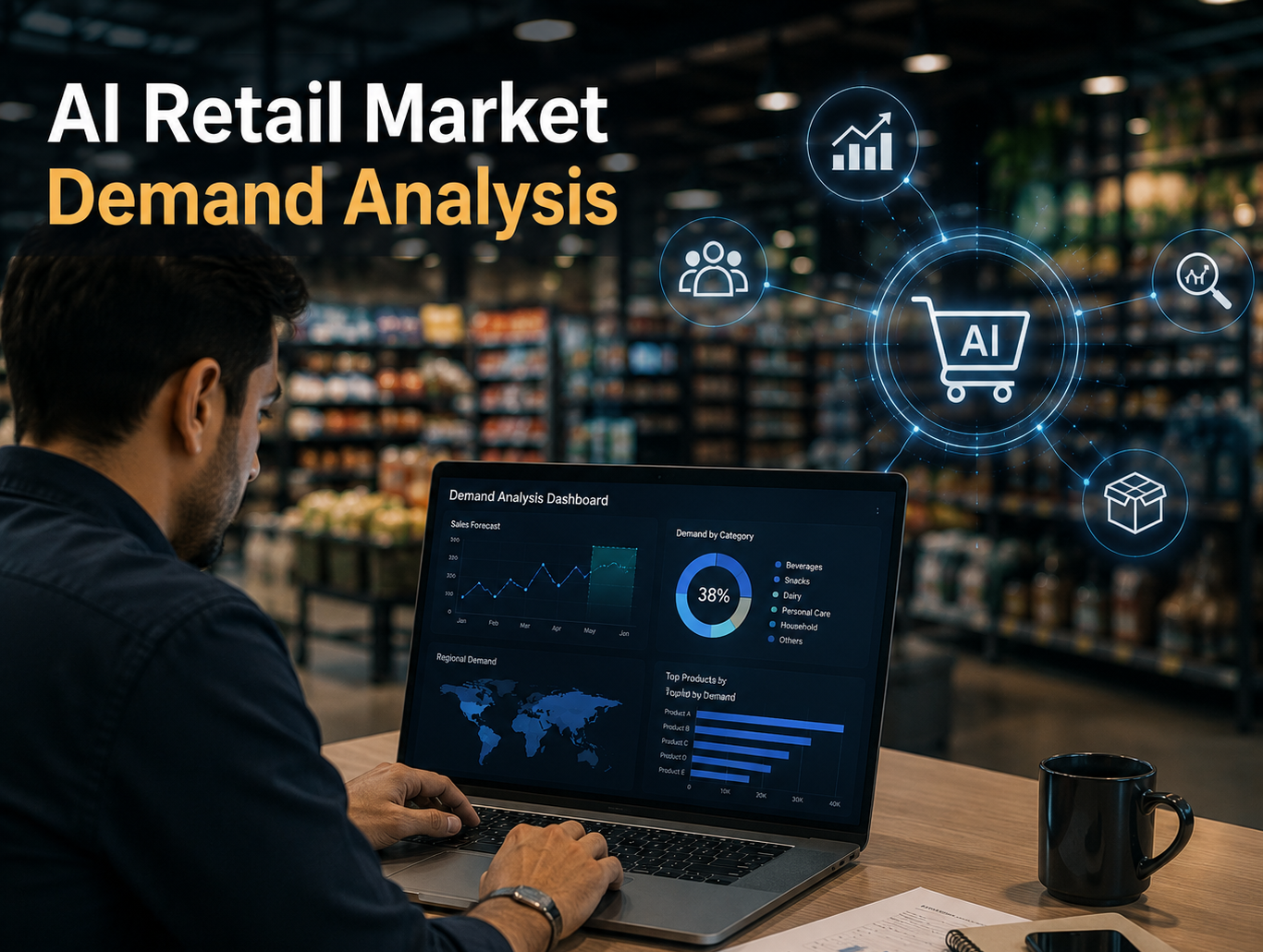
Retail markets change quickly as customer preferences, purchasing habits, economic conditions, pricing strategies, seasonal trends, and competitive activity continue to evolve. Retailers need a clear understanding of these changes to make better decisions about products, inventory, pricing, promotions, and expansion. Traditional market analysis often depends on historical reports and manual interpretation, which can take considerable time and may overlook important relationships within large datasets. AI offers a more intelligent approach by examining extensive market information, identifying emerging patterns, and helping retailers understand where demand may increase or decline. Through Retail Market Demand Analysis, businesses can gain deeper market visibility and make decisions based on current evidence rather than assumptions.
Retail Market Demand Analysis
Retailers Need AI Demand Analysis
Retailers must make decisions while dealing with changing customer expectations and unpredictable market conditions. Manual analysis may not identify these changes quickly enough, especially when businesses manage thousands of products across multiple locations and channels. AI can examine large amounts of information rapidly and highlight meaningful changes. Retailers can use these insights to respond faster, reduce uncertainty, and align their strategies with actual market behavior.
How AI Analyzes Retail Demand ?
AI combines information from sales systems, customer platforms, inventory applications, e-commerce channels, marketing campaigns, pricing databases, and external market sources. Machine learning algorithms examine relationships among these datasets and identify patterns that influence customer demand. The system can recognize recurring behavior, unusual changes, growing product interest, and declining categories. As retailers add new information, AI models can learn from recent outcomes and improve their understanding of market conditions. This continuous analysis helps businesses maintain a more current view of demand.
Identifying Emerging Market Trends
Market trends can develop quickly, particularly in categories influenced by fashion, technology, lifestyle changes, and social media activity. AI can analyze historical information and current signals to detect unusual increases in product interest. When demand begins to move in a new direction, intelligent systems can highlight the change for retail teams. Early trend recognition gives businesses more time to evaluate opportunities, prepare inventory, adjust promotions, and respond to customer expectations.
Analyzing Regional Demand
Customer preferences can vary significantly between regions. AI can compare sales and customer activity across different geographic areas to identify these variations. Retailers can use regional insights to customize product assortments, inventory distribution, promotions, and pricing strategies. This approach helps businesses avoid applying the same market assumptions to every location.
Real-Time Market Signals
Real-time information from point-of-sale systems, online searches, digital interactions, inventory platforms, and marketing campaigns can provide immediate signals about customer interest. AI can process these signals and identify changes as they occur. Retailers can use current information to respond to emerging demand rather than waiting for periodic reports that may already reflect outdated conditions.

Define Clear Business Objectives
Retailers should first identify the main goals they want to achieve with AI demand analysis. These goals may include improving demand forecasting, identifying emerging market trends, optimizing product assortment, or strengthening inventory planning. Clear objectives help businesses select the right data, tools, and analytical approach.
Collect and Prepare Relevant Data
Retailers should gather information from sales systems, customer platforms, inventory applications, e-commerce channels, pricing records, promotional campaigns, and suitable external sources. After collecting the information, teams should correct errors, remove duplicate records, address missing values, and maintain consistent product and location classifications to create reliable data for analysis.
Integrate AI Insights Into Retail Operations
Retailers should connect analytical insights with important business workflows, including inventory management, merchandising, marketing, pricing, and planning. This integration allows teams to use demand intelligence during everyday decision-making rather than treating AI analysis as a separate reporting activity.

Monitor and Improve the AI System
Retailers should continuously monitor model performance and review how accurately the system responds to changing customer behavior and market conditions. Teams can update the models with new information and refine the system when demand patterns change. Continuous improvement helps businesses maintain relevant and useful demand insights over time.
Challenges
AI demand analysis depends on accurate, relevant, and well-organized information. Poor data quality, incomplete customer records, inconsistent product classifications, limited historical information, and sudden market disruptions can affect analytical results. Retailers also need to consider privacy and security when they process customer information. Businesses should combine AI recommendations with human expertise rather than relying on automated results alone. Regular model evaluation, strong data governance, and clear business oversight can help retailers maintain dependable insights.
Conclusion
AI gives retailers a powerful way to understand changing customer demand, identify emerging opportunities, and make better market decisions. An experienced AI development company can help businesses create customized solutions that match their operational requirements and integrate intelligent analysis into existing retail systems. By combining reliable data, machine learning, continuous monitoring, and human expertise, retailers can respond to market changes with greater speed and make decisions that support sustainable growth.