
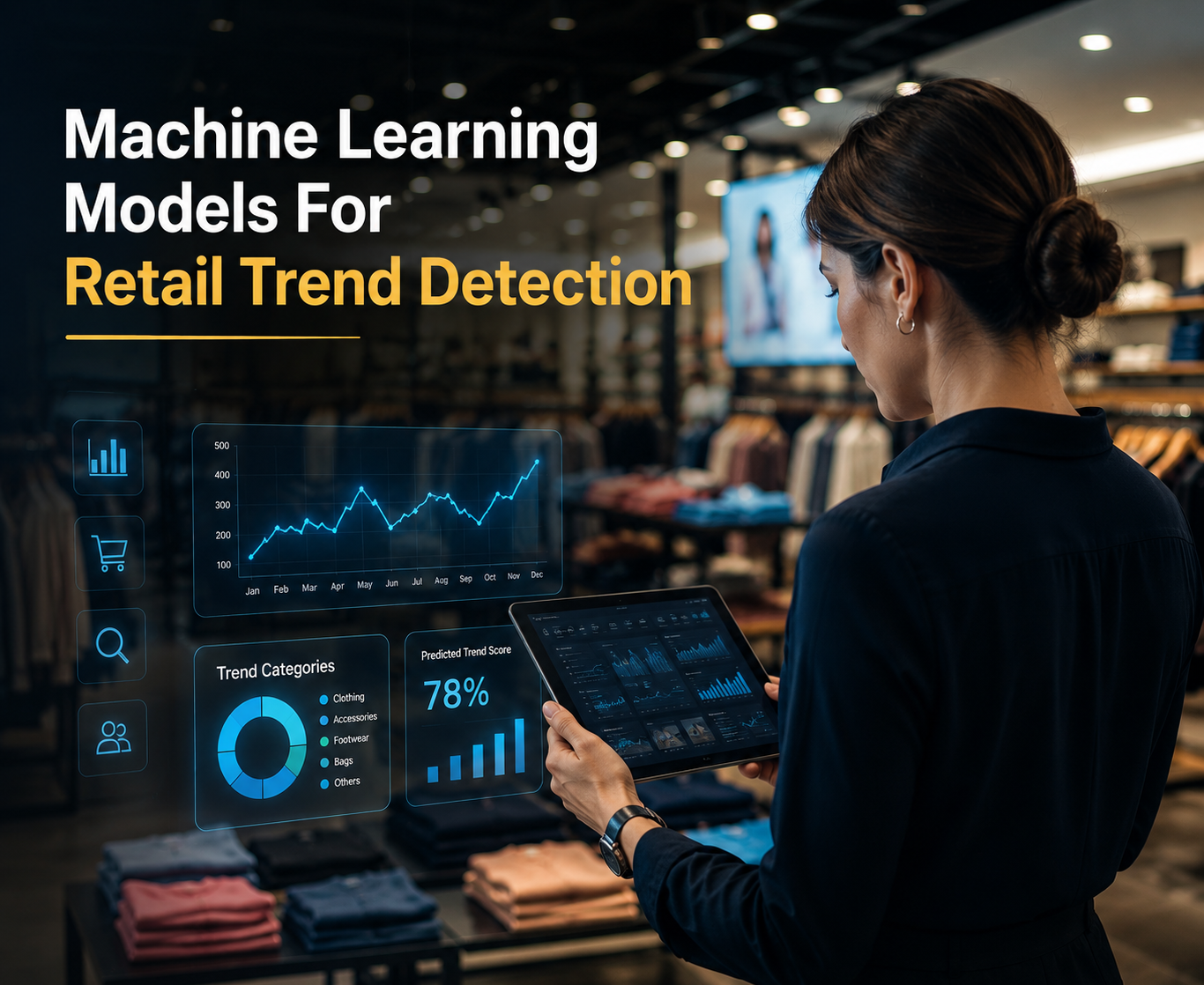
Retail markets change continuously as customer preferences, purchasing habits, seasonal influences, pricing conditions, and competitive activity evolve. Traditional methods often depend on historical reports and manual observation, which can make it difficult to identify subtle changes across large datasets. Machine learning provides retailers with a practical way to analyze sales records, customer interactions, product performance, search behavior, and market signals. Through Retail Trend Detection, businesses can identify emerging patterns, understand changing customer interests, and make faster decisions based on meaningful data.
Retail Trend Detection
Retailers Need ML for Trend Detection
Customer preferences can shift quickly because of seasonal events, social media influence, economic changes, new products, competitor activity, and changing lifestyles. Retailers that recognize these movements early can respond before competitors and avoid decisions based on outdated information. Machine learning can process information continuously and identify meaningful changes across products, stores, regions, and customer segments. This capability helps retailers move from reactive planning toward proactive decision-making.
How Machine Learning Detects Retail Trends?
Machine learning models analyze historical and current information to identify patterns associated with changing demand. Retailers can provide sales transactions, product information, customer activity, search behavior, promotional results, pricing data, and other relevant signals. The models examine relationships among these variables and identify movements that may indicate an emerging trend. As new information becomes available, retailers can update the models and improve their ability to recognize changing market conditions.
Time Series Models for Trend Detection
Time series models analyze data collected over specific periods and help retailers understand how demand changes over time. These models can identify recurring seasonal patterns, growth movements, declining activity, and unusual fluctuations. Retailers can apply time series techniques to sales, product demand, website traffic, and category performance.
Regression Models for Retail Trends
Regression models help retailers understand relationships between different business factors and sales outcomes. A retailer can analyze how price changes, promotions, advertising activity, seasonal conditions, or customer engagement influence product performance. These models can highlight factors associated with rising or declining demand and provide useful information for trend analysis. Retail teams can then use these findings to support pricing, marketing, and merchandising decisions.
Decision Trees for Trend Analysis
Decision tree models can help retailers understand which factors contribute to specific outcomes. A retailer can use this approach to examine why certain products experience stronger demand under particular conditions. The model can organize relevant factors into understandable decision paths, making the resulting insights easier for business teams to interpret. Retailers can use these findings to improve assortment planning, promotional strategies, and customer targeting.
Neural Networks for Complex Retail Patterns
Neural networks can process complex relationships across large datasets and identify patterns that involve multiple variables. Retailers with extensive transaction histories and diverse customer interactions can use neural network models to analyze complicated demand behavior. These models can support trend identification when product interest depends on several interacting factors, such as pricing, promotions, seasonality, customer preferences, and market activity.

Detecting Emerging Product Trends
Machine learning can help retailers identify products that show increasing customer interest before the trend becomes widely established. Models can examine sales growth, search activity, product views, customer engagement, and repeat purchases to detect early signals. Retailers can use these insights to review inventory requirements, marketing opportunities, and product placement strategies before demand increases significantly.
Roles
Collect and Prepare Data
Retailers should gather sales transactions, customer interactions, product information, pricing records, promotional results, search behavior, inventory data, and relevant market signals. Teams should clean the information, remove duplicate records, address missing values, and maintain consistent product and customer classifications.
Suitable Machine Learning Models
Retailers should choose models according to their trend detection requirements. Time series models can analyze changes over time, clustering can identify similar customer or product groups, classification can categorize trends, and neural networks can analyze complex relationships. Selecting an appropriate model improves the usefulness of the resulting insights.
Train and Evaluate the Models
Teams should train models using historical information and compare their findings with known market outcomes. Retailers can evaluate whether the system correctly identifies meaningful trends and distinguish valuable signals from temporary fluctuations. Regular testing helps improve model reliability.
Monitor and Refine Trend Detection
Market conditions continue to change, so retailers should monitor model performance and update the system with new information. Teams can refine models when customer behavior, product categories, or market conditions change. Continuous improvement helps maintain relevant trend intelligence.
Challenges
Machine learning requires reliable information to produce useful insights. Inconsistent product records, incomplete customer data, limited historical information, sudden market disruptions, and temporary demand spikes can affect trend detection. Retailers should also avoid treating every unusual movement as a long-term trend. Human expertise remains important for interpreting machine learning results and understanding the business context behind market changes.
Conclusion
Machine learning gives retailers a practical way to identify changing customer preferences, emerging product opportunities, declining demand, regional differences, and seasonal movements. An experienced AI development company can help retailers build customized solutions that integrate trend intelligence with existing business systems. By combining quality data, suitable machine learning models, continuous monitoring, and human expertise, retailers can recognize market changes earlier, respond with greater confidence, and build strategies that support long-term growth.