
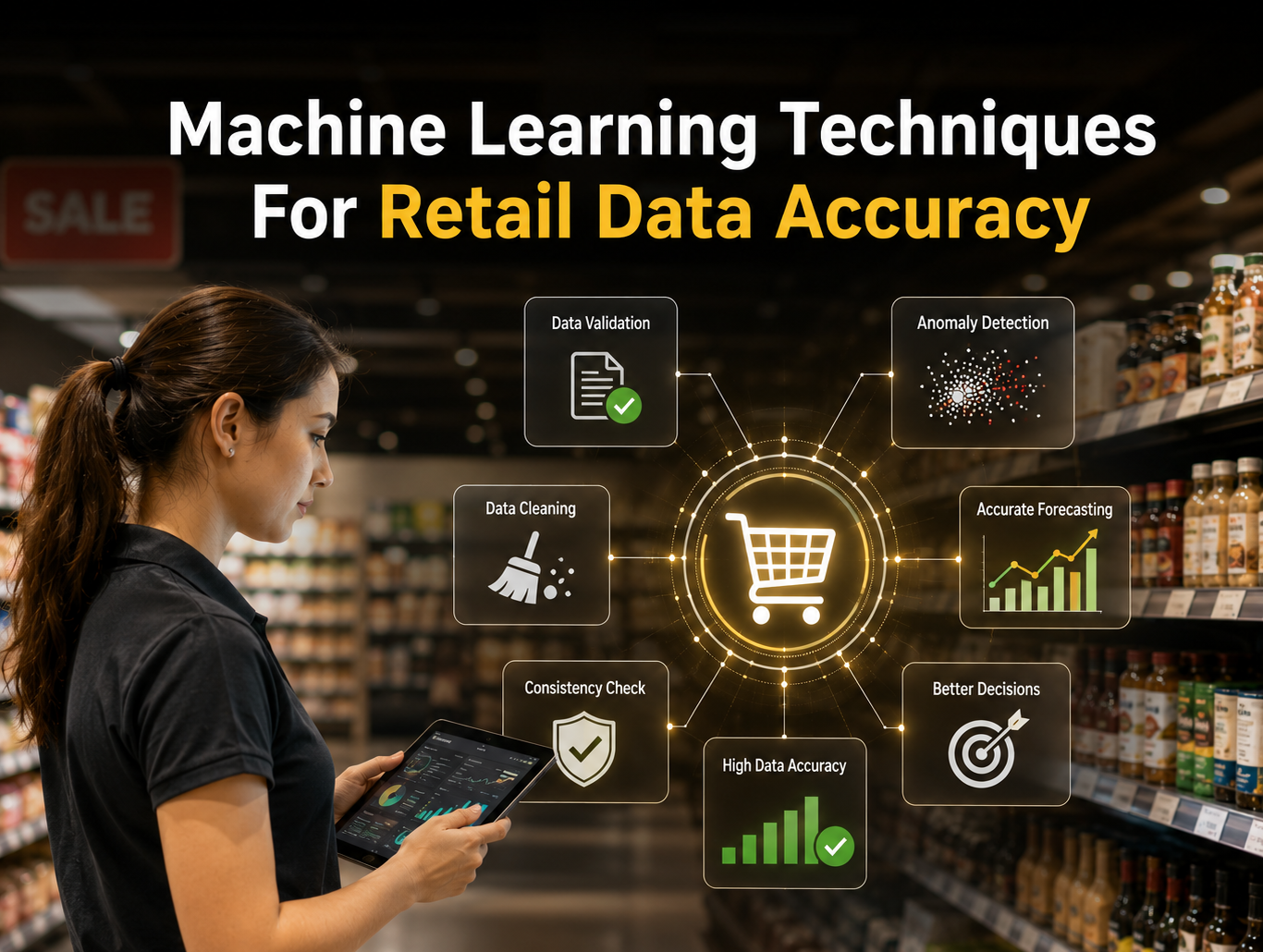
Retail businesses depend on information at nearly every stage of the customer journey. Product details guide shoppers, inventory records support fulfillment, transaction data shapes financial reporting, and customer information influences marketing and service. When these records contain errors, the impact can spread across multiple departments. Machine learning can help retailers detect, correct, and prevent many forms of data quality issues. By combining predictive techniques with strong governance and human review, businesses can improve Retail Data Accuracy and create a more dependable foundation for daily operations and long-term planning.
Retail Data Accuracy
How Does ML Support Data Quality?
Machine learning can identify patterns that rule-based checks often miss. Algorithms can learn from historical corrections, known duplicates, transaction behavior, and trusted reference data. They can then assign risk scores to records that appear suspicious or recommend likely corrections. This approach does not remove the need for business rules. Instead, it adds a predictive layer that helps data teams focus their attention on the records most likely to require investigation.
Product Data Validation
Machine learning can identify values that appear inconsistent with comparable products or category norms. A model may detect an unusual screen size in a television catalog, an unlikely clothing measurement, or a product description that does not match its assigned category. These signals can help catalog teams investigate potential errors before customers encounter them. Automated checks can operate continuously as new products arrive, making quality control more proactive. Better product information also improves search, recommendations, advertising, marketplace listings, and customer service.
Duplicate Record Detection
Duplicate records are common when information enters a retail system through several channels. Products can also receive duplicate entries when different teams create similar catalog records. Machine learning can compare multiple attributes and estimate whether two records represent the same entity. A confidence score can help reviewers separate clear matches from uncertain cases. This approach can reduce duplication while avoiding overly aggressive merges that might combine unrelated records.
Price Accuracy Monitoring
Retail pricing can change frequently across stores, websites, promotions, regions, and channels. Machine learning can monitor pricing records and detect unusual differences that may indicate data-entry mistakes, synchronization failures, or unexpected updates. Models can compare current values with historical patterns, related products, promotional calendars, and channel-specific rules. A flagged anomaly does not necessarily mean the price is wrong, so appropriate validation remains important. The benefit comes from directing attention toward changes that deserve review instead of asking teams to inspect every record manually.

Inventory Data Accuracy
Inventory information influences purchasing, replenishment, fulfillment, store operations, and customer promises. Machine learning can compare sales activity, receiving records, returns, transfers, warehouse movements, and historical patterns to identify unusual inventory behavior. A model can highlight locations or products where recorded quantities do not align with expected movement. These signals can help teams investigate cycle-count issues, process gaps, delayed updates, or other causes. More dependable inventory information supports better availability while reducing operational surprises.
Anomaly Detection for Transactions
Retail transactions contain patterns that can help teams identify unusual activity. These anomalies may indicate data errors, process problems, or activity that requires further investigation. The model should not automatically label an unusual transaction as fraudulent or incorrect. Instead, it can prioritize cases for review. This approach can improve monitoring efficiency while giving human teams the context needed to make final decisions.
NLP For Product Content
Retailers often manage descriptions, titles, specifications, reviews, and other text-heavy information. Natural language processing can examine this content for missing attributes, inconsistent terminology, unusual wording, or mismatches between descriptions and structured fields. These capabilities can help teams improve product records while making search and discovery more effective.

Missing Data Prediction
Missing values can weaken forecasts, recommendations, reports, and operational workflows. Machine learning can estimate which missing fields are likely to contain useful information and help teams prioritize completion. For some structured attributes, a model may predict a plausible value based on similar products or related records. Such predictions should remain clearly identified as suggestions rather than confirmed facts. Human or source-system validation should occur before important information becomes authoritative. This careful approach can accelerate data completion without turning uncertain estimates into permanent records.
Supplier Data Quality Management
Supplier information can vary widely in structure, completeness, terminology, and update frequency. Machine learning can assess incoming product files and identify records that differ from expected patterns before they enter the main catalog. Models can learn which fields frequently require correction for particular suppliers and prioritize those submissions for review. Retailers can use these insights to provide targeted feedback to suppliers instead of repeatedly fixing the same issues internally. Over time, this can improve the quality of information at its source and reduce downstream correction work.
Data Quality In Omnichannel Retail
Modern retailers often synchronize information across websites, mobile applications, marketplaces, stores, warehouses, and customer service platforms. Each connection creates an opportunity for mismatched records or delayed updates. Machine learning can monitor relationships across channels and identify situations where information appears inconsistent. A product may show different availability on two channels, or a price update may reach one platform before another. Detecting these differences quickly can help teams correct synchronization issues before they affect customers. Reliable cross-channel information supports a more consistent shopping experience.

Predictive Data Quality Monitoring
Predictive monitoring takes a more proactive approach by estimating where problems are likely to appear. Machine learning can study historical incidents, source-system behavior, update patterns, and field-level changes to identify conditions associated with future errors. Teams can then investigate high-risk sources or workflows before problems spread. This can shift data management from periodic cleanup toward continuous prevention. Retailers can prioritize resources according to risk rather than treating every record as equally likely to contain an issue.
Strong Data Governance Framework
Machine learning performs better when the organization has clear definitions, ownership, access controls, and quality standards. Retailers should identify authoritative sources for important fields and establish rules for how information moves between systems. Data owners can define acceptable values, update schedules, validation requirements, and escalation procedures. Governance also needs to address privacy, security, retention, and responsible use. A strong framework gives machine learning models reliable boundaries and helps employees understand who should resolve a problem when the system identifies an anomaly.
Conclusion
Machine learning can give retailers a practical way to improve Retail Data Accuracy across product catalogs, customer records, inventory, pricing, transactions, supplier information, and omnichannel systems. The strongest results come from combining these techniques with accurate source data, clear governance, human review, and measurable business goals. Better information supports better decisions, smoother operations, and more dependable customer experiences. When retailers treat data quality as an ongoing business capability rather than a one-time cleanup project, machine learning can help create a stronger foundation for sustainable growth.