
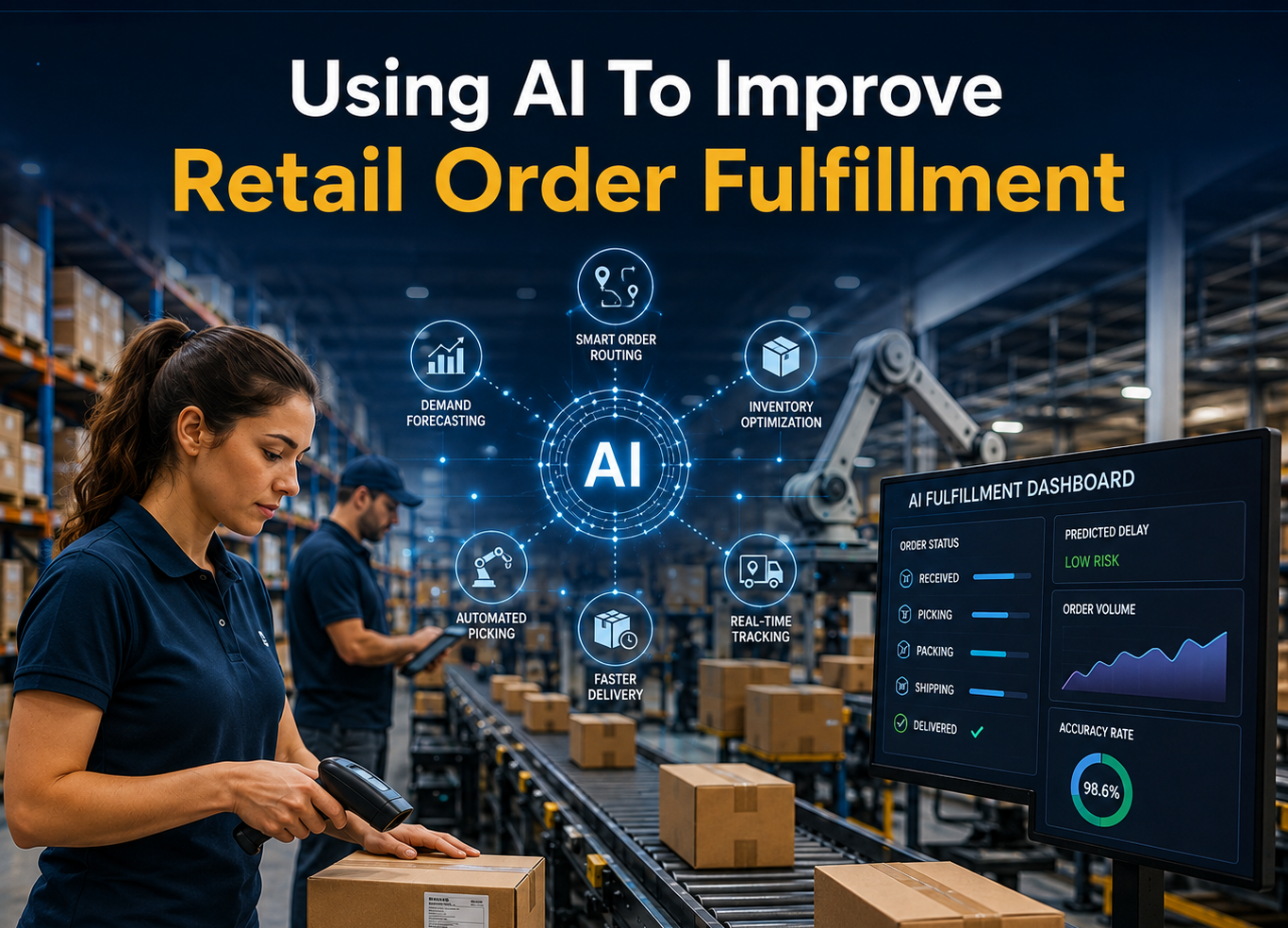
Retail customers expect orders to move smoothly from checkout to delivery. Behind that experience sits a complex chain involving inventory records, warehouse capacity, picking, packing, carrier coordination, payment confirmation, and customer communication. A delay at one stage can affect every step that follows. Artificial intelligence can help retailers improve this chain by predicting demand, selecting suitable fulfillment locations, prioritizing urgent orders, identifying bottlenecks, and anticipating delivery problems. When applied thoughtfully, AI can make Retail Order Fulfillment faster, more accurate, and easier to manage while helping businesses control operating costs and maintain a dependable customer experience.
Retail Order Fulfillment
How Does AI Change The Fulfillment Process?
AI Order Allocation
A retailer may have the item in several stores or distribution centers, yet each option can have different inventory accuracy, distance, workload, labor availability, and transportation costs. AI can compare these factors and select an appropriate source. A model can also consider promised delivery dates and the likelihood that a particular location can complete the order successfully. Better allocation reduces unnecessary transfers, shortens travel distance, and helps retailers use their network more effectively.
Inventory Visibility And Accuracy
AI can compare sales activity, stock movements, returns, transfers, reservations, and warehouse records to identify suspicious discrepancies. Predictive models can also estimate whether an item shown as available is likely to remain accessible when an order reaches the picking stage. Better visibility creates a stronger foundation for allocation and delivery promises. Retailers should distinguish physical units from reserved, damaged, unavailable, and sellable quantities when building these systems.
Demand Forecasting For Fulfillment Planning
AI forecasting can estimate future demand at different levels, such as product, location, channel, or time period. These predictions help retailers prepare labor, warehouse space, packaging supplies, and transportation capacity. A useful forecasting process should account for uncertainty instead of presenting one number as a guaranteed outcome.
Intelligent Packing Decisions
Packing affects shipping cost, product protection, handling time, and customer satisfaction. AI can recommend suitable packaging based on item dimensions, fragility, quantity, destination, and carrier requirements. Models can also identify combinations that require additional protection or special handling. Retailers should evaluate packaging recommendations alongside sustainability goals, damage rates, labor effort, and transportation economics rather than optimizing a single metric.

Predicting Delivery Delays
Delivery delays can arise from warehouse congestion, carrier capacity, weather, address issues, transportation disruptions, or inaccurate processing estimates. AI can combine internal order information with relevant external signals to identify shipments that may miss their promised dates. Early detection gives customer service and operations teams time to intervene. Predictive alerts are most useful when they connect directly with an action plan.
Real-Time Fulfillment Monitoring
Real-time analytics can monitor order queues, processing rates, inventory availability, picking activity, packing capacity, and dispatch performance. AI can identify unusual changes and estimate where congestion may develop next. Managers can then redirect labor, adjust priorities, or activate contingency procedures. Not every process requires second-by-second analysis, so retailers should reserve real-time infrastructure for situations where rapid intervention creates value.

Managing Omnichannel Fulfillment
Omnichannel retail requires inventory and fulfillment decisions to work across ecommerce, stores, marketplaces, and other customer touchpoints. A product may be available in several places, but each location can have different operational constraints. AI can evaluate these options and determine how to fulfill orders without creating unnecessary disruption to store activities. A coordinated approach allows retailers to use their physical network as a flexible fulfillment resource.
Cost Optimization
Speed is important, but retailers must also control the cost of each completed order. AI can evaluate these factors together and identify trade-offs between speed, service quality, and expense. A model may recommend a different fulfillment location or carrier when the change preserves the delivery promise while reducing cost. Retailers should avoid optimizing a single measure because the cheapest option may increase delays or returns. A balanced objective creates healthier economics across the entire fulfillment network.

Data Quality And System Integration
AI cannot improve fulfillment reliably when the underlying information is incomplete or inconsistent. Retailers should connect order management, warehouse systems, inventory platforms, transportation tools, customer records, and relevant external feeds. Shared identifiers and clear business definitions help models interpret information correctly. Data pipelines should monitor freshness, duplicates, missing fields, and unexpected changes. A reliable data foundation is one of the most important requirements for successful AI adoption.

Conclusion
AI can help retailers improve Retail Order Fulfillment by making allocation smarter, inventory visibility stronger, warehouse activity more efficient, delivery estimates more reliable, and exception management more proactive. The greatest value comes from connecting predictive intelligence with practical workflows. When businesses balance delivery speed with accuracy, cost, resilience, and customer expectations, AI becomes more than an automation tool.