
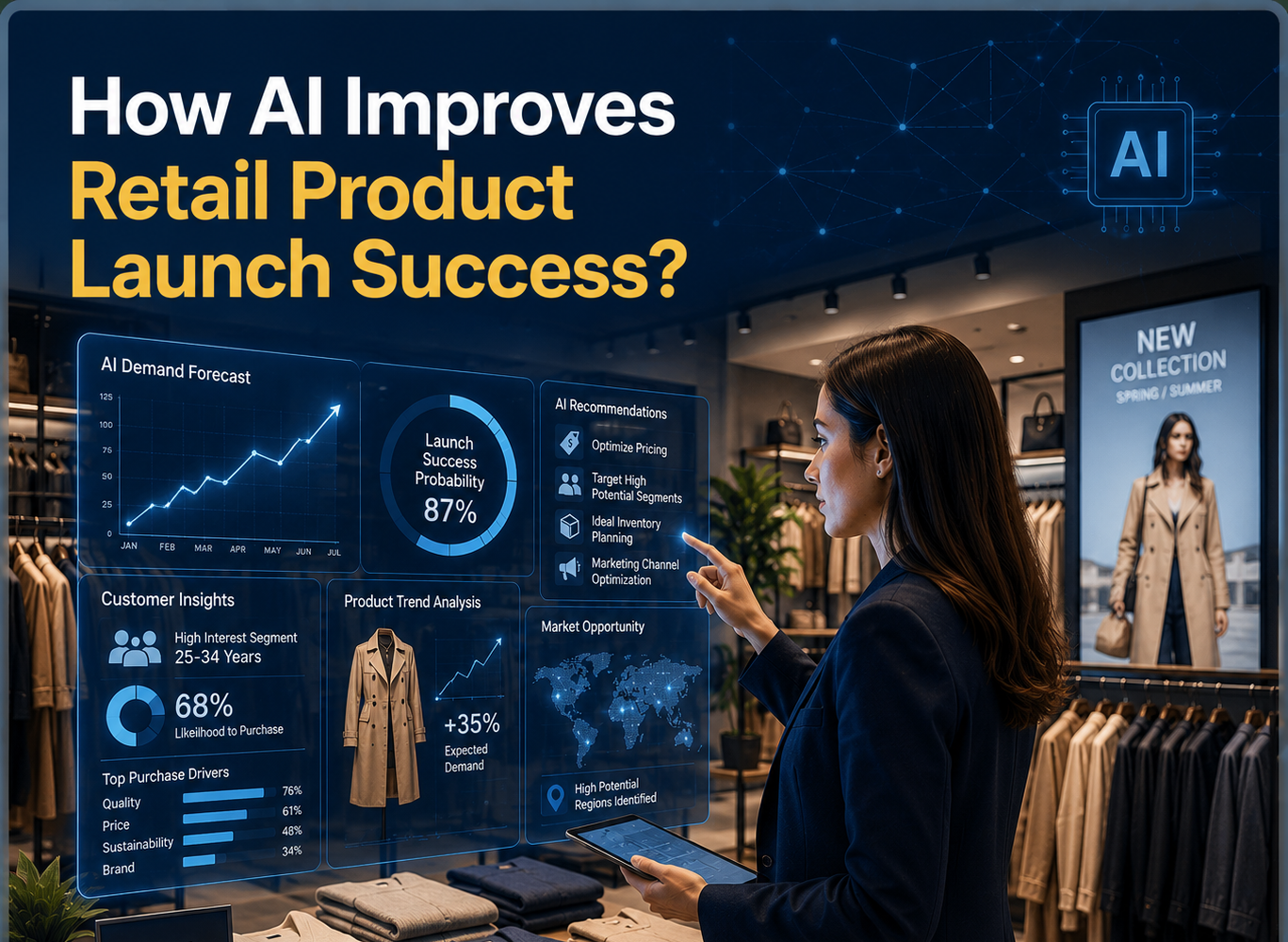
Launching a new retail product is rarely a single event. It is a coordinated process involving customer research, product positioning, pricing, inventory planning, marketing, distribution, store operations, and post-launch evaluation. Artificial intelligence is changing how retailers prepare for these challenges by helping teams interpret large datasets, anticipate demand, understand shopper preferences, and identify risks before a product reaches the market. When applied thoughtfully, AI can strengthen Retail Product Launch Success by turning scattered information into practical guidance.
Retail Product Launch Success
AI Customer And Market Research
Understanding the intended audience is one of the foundations of a strong product introduction. AI can analyze customer reviews, search behavior, and product interactions to uncover preferences and unmet needs. Natural language processing can group large collections of comments into themes, helping retailers recognize what shoppers appreciate, what frustrates them, and which features they repeatedly request. Sentiment analysis can add another layer by indicating whether reactions are favorable, mixed, or negative.
Optimizing Pricing And Promotional Strategy
Price has a direct influence on perceived value, purchase intent, margin, and inventory movement. AI can examine historical pricing behavior, category benchmarks, demand patterns, customer responses, competitor signals, and promotional outcomes to help retailers evaluate different price scenarios. This can support decisions about introductory offers, discounts, bundles, loyalty incentives, and timing. Intelligent analysis can also reveal whether a promotion attracts genuinely incremental demand or simply shifts purchases that would have happened anyway.
Smarter Demand Forecasting
AI forecasting can combine historical category performance with factors such as seasonality, promotional activity, location, customer segments, pricing, online interest, and comparable product behavior. Machine learning models can identify relationships across these variables and produce demand estimates that can be updated as new information becomes available.
Personalized Product Positioning
A single product can appeal to different shoppers for different reasons. AI can help retailers identify these distinctions by analyzing customer characteristics and behavioral patterns. The resulting insights can support audience segmentation and more relevant positioning. Marketing teams can develop different messages for distinct groups instead of presenting every shopper with identical language.
Improving Marketing Campaign Performance
Product launches often involve multiple channels, including search advertising, social media, email, influencer activity, retail displays, websites, mobile applications, and marketplace placements. AI can help compare performance across these touchpoints by examining engagement, conversion, audience response, creative variations, and purchase behavior. Predictive models can identify audiences that show stronger purchase potential, while generative tools can assist with variations of headlines, descriptions, promotional concepts, and campaign copy that still require human review.

Inventory And Distribution Planning
A product can have strong demand and still disappoint customers if it is unavailable where and when they want it. AI can support allocation decisions by considering expected demand across stores, regions, ecommerce channels, customer groups, and fulfillment points. These models can help planners anticipate differences between locations rather than distributing identical quantities everywhere. As actual sales arrive, the system can compare forecasts with real movement and highlight areas where replenishment or redistribution may be needed.
Real-Time Launch Monitoring
AI monitoring can bring together sales results, website behavior, product ratings, customer questions, social reactions, returns, and service interactions to create a more complete view of early performance. A sudden rise in negative comments may indicate a packaging problem, unclear instructions, a quality concern, or an expectation mismatch.

Reducing Launch Risk
Every new product carries uncertainty, but AI can help retailers identify areas where exposure may be higher. Predictive analysis can flag unusual demand patterns, weak audience engagement, potential inventory imbalance, negative sentiment, or promotional performance that differs from expectations. Scenario modeling can also help teams consider what might happen if demand is higher or lower than planned, if a campaign performs differently across channels, or if supply conditions change.

Measuring Launch Performance
A strong launch measurement framework should examine more than first-week revenue. Retailers can monitor awareness, product-page engagement, conversion, average order value, customer acquisition cost, margin, inventory velocity, return rates, review sentiment, repeat purchases, and promotional efficiency. AI can bring these measures together and identify relationships that may explain why performance is strong or weak.
Retailers Implement AI Effectively
Retailers should determine which launch decisions would benefit most from improved intelligence, establish reliable data sources, define useful performance measures, and create clear ownership for acting on findings. Models should be tested against realistic examples and reviewed regularly for accuracy and bias. Expertise should remain part of the workflow because commercial context, brand considerations, operational constraints, and customer expectations cannot always be captured by a model.
Conclusion
AI is reshaping the way retailers prepare, execute, and evaluate new product introductions. Retail Product Launch Success depends on many connected factors, and AI can help organizations understand those factors with greater speed, scale, and precision. The strongest results come when technology is paired with reliable information, clear objectives, experienced professionals, and a willingness to adapt when customer behavior changes. .