
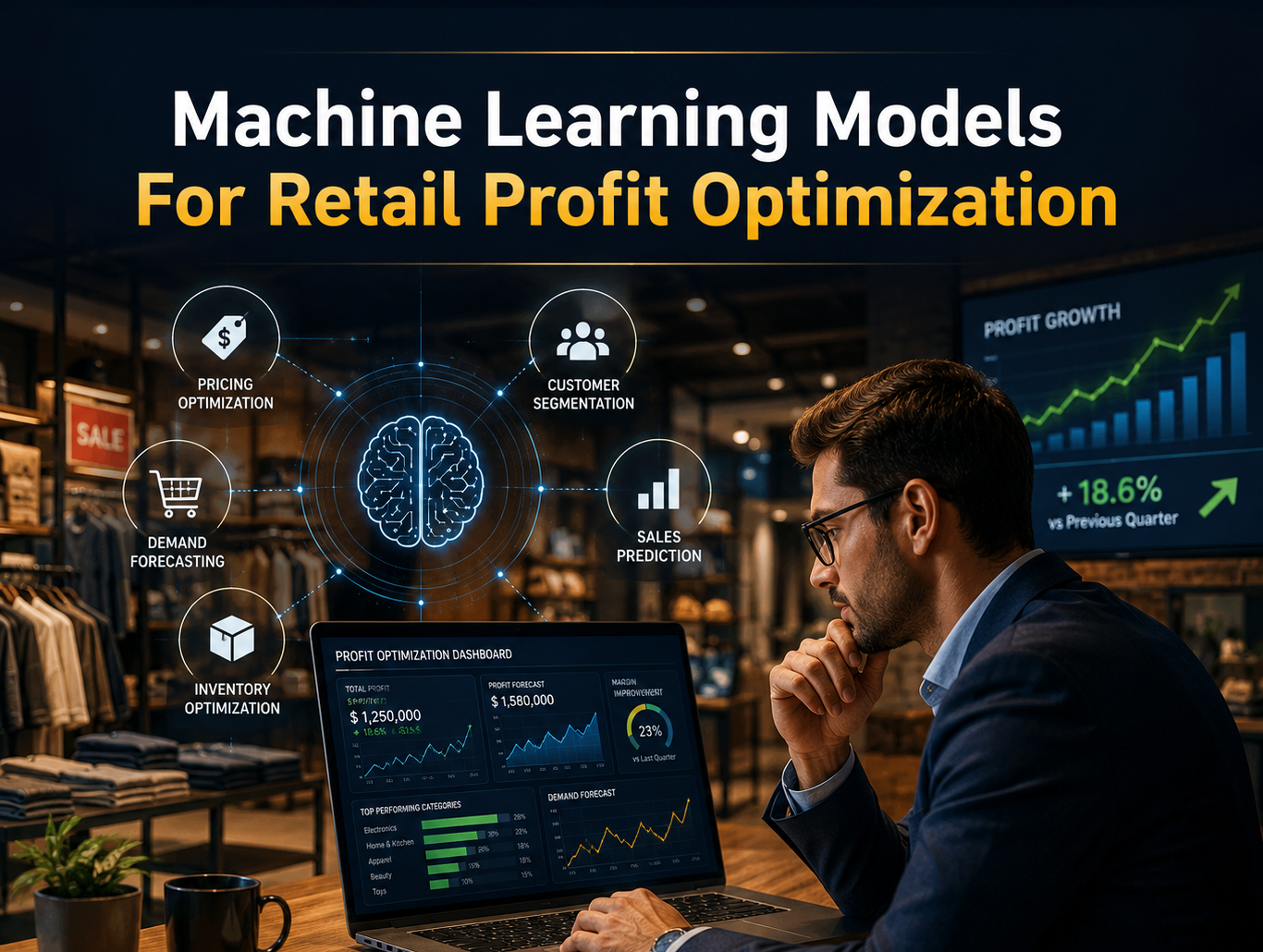
Retail profitability depends on more than increasing sales. Pricing, inventory, promotions, product selection, operating expenses, customer retention, and demand patterns all influence the amount a business ultimately earns. Retailers often have access to large quantities of commercial data, but turning that information into timely profit-focused decisions can be difficult. Machine learning provides a practical way to examine complex relationships and estimate how different decisions may affect financial performance. With effective Retail Profit Optimization, businesses can identify profitable opportunities while reducing avoidable costs and improving resource allocation.
Retail Profit Optimization
How Does ML Support Profit Decisions?
Demand Forecasting and Profitability
Accurate demand forecasts are central to profitable retail operations. If demand is underestimated, businesses may lose sales because products are unavailable. If it is overestimated, excess stock can lead to markdowns, storage expenses, and waste. Machine learning can use historical sales, seasonality, promotions, holidays, and other relevant signals to estimate future demand. Better forecasts allow retailers to align purchasing and inventory with expected sales while protecting margins.
Intelligent Pricing Decisions
Pricing has a direct relationship with revenue and margin. Machine learning can study how customers responded to previous price changes and identify factors that influence demand. Models can estimate expected sales under different price points and help retailers evaluate potential outcomes before making changes. Pricing teams can use these insights alongside competitive information, brand positioning, inventory conditions, and commercial policies to select prices that support broader financial objectives.

Optimizing Promotional Campaigns
Promotions can increase traffic and sales, but not every discount creates meaningful incremental profit. Machine learning can examine previous campaigns to determine which products, customer groups, channels, and offers produced strong results. It can also identify situations where a promotion mainly shifts purchases that would have happened anyway. This helps retailers design campaigns with clearer financial objectives and avoid unnecessary discounting.
Inventory And Margin Management
Inventory decisions affect both availability and profitability. Holding excessive stock ties up capital and can eventually require markdowns, while insufficient supply can result in missed revenue. Machine learning can combine demand forecasts, current inventory, replenishment information, product margins, and sales velocity to highlight items that need attention. Retailers can use these insights to prioritize replenishment, reduce excess stock, and protect profitable products.
Product Assortment Optimization
The products a retailer chooses to carry can strongly influence financial performance. Some items generate high volume, while others contribute stronger margins or encourage complementary purchases. Machine learning can evaluate product-level performance and identify relationships between items, categories, locations, and customer preferences. This information can support assortment decisions that balance sales potential, margin contribution, shelf space, and inventory risk.
Supply Chain Cost Optimization
Profitability can be affected by purchasing costs, transportation, warehousing, supplier performance, and fulfillment efficiency. Machine learning can analyze historical operational information to identify recurring cost patterns and potential inefficiencies. Forecasts can also support better purchasing and logistics planning. By improving coordination between expected demand and supply activities, retailers can reduce avoidable expenses while maintaining product availability.

Reducing Customer Churn
Customer retention can influence long-term profitability because acquiring new buyers may require considerable marketing investment. Machine learning can identify patterns associated with declining engagement, reduced purchase frequency, or other signals of potential churn. Retail teams can use these insights to design timely retention initiatives. The goal is not to contact every customer with a discount, but to identify situations where a thoughtful intervention may preserve a valuable relationship.
Measuring Price Sensitivity
Customer response to price changes varies by product, category, customer group, and market. Machine learning can help estimate price sensitivity by examining historical transactions and surrounding conditions. Understanding elasticity allows retailers to distinguish products where a small price change may have a significant demand effect from those with more stable purchasing behavior. These insights can support more precise commercial planning.
Detecting Profit Leakage
Profit can decline through many small issues, including excessive discounting, high return rates, inventory waste, pricing errors, inefficient fulfillment, or unexpected operating costs. AI anomaly detection can help identify unusual changes in financial or operational patterns. Once an issue is highlighted, teams can investigate the underlying cause and determine whether corrective action is needed. Early detection can prevent small inefficiencies from becoming larger financial problems.
Store And Regional Profitability
Different locations can have different cost structures, customer preferences, competition, and demand patterns. Company-wide averages may hide these differences. Machine learning can evaluate store-level information and identify locations with unusual margin, sales, inventory, or expense patterns. Regional leaders can use these findings to adjust assortments, staffing, pricing, promotional activity, and stock allocation according to local conditions.
Data Quality And Model Reliability
The quality of a profit optimization model depends on the quality of the information behind it. Missing transactions, inconsistent product identifiers, inaccurate costs, delayed updates, and incorrect margin data can weaken predictions. Retailers should establish strong data governance, validation processes, and monitoring practices before relying heavily on model outputs. Regular review also helps detect changes in market behavior that may reduce model accuracy over time.

Conclusion
Machine learning can help retailers move from reactive financial reporting toward more proactive profit management. By forecasting demand, evaluating price sensitivity, improving promotions, optimizing inventory, understanding customer value, and detecting profit leakage, intelligent models can support better commercial decisions. Retail Profit Optimization is most effective when technology is combined with trustworthy data, measurable goals, and experienced human oversight. Used responsibly, machine learning can help retailers protect margins, allocate resources wisely, and build stronger long-term financial performance.