
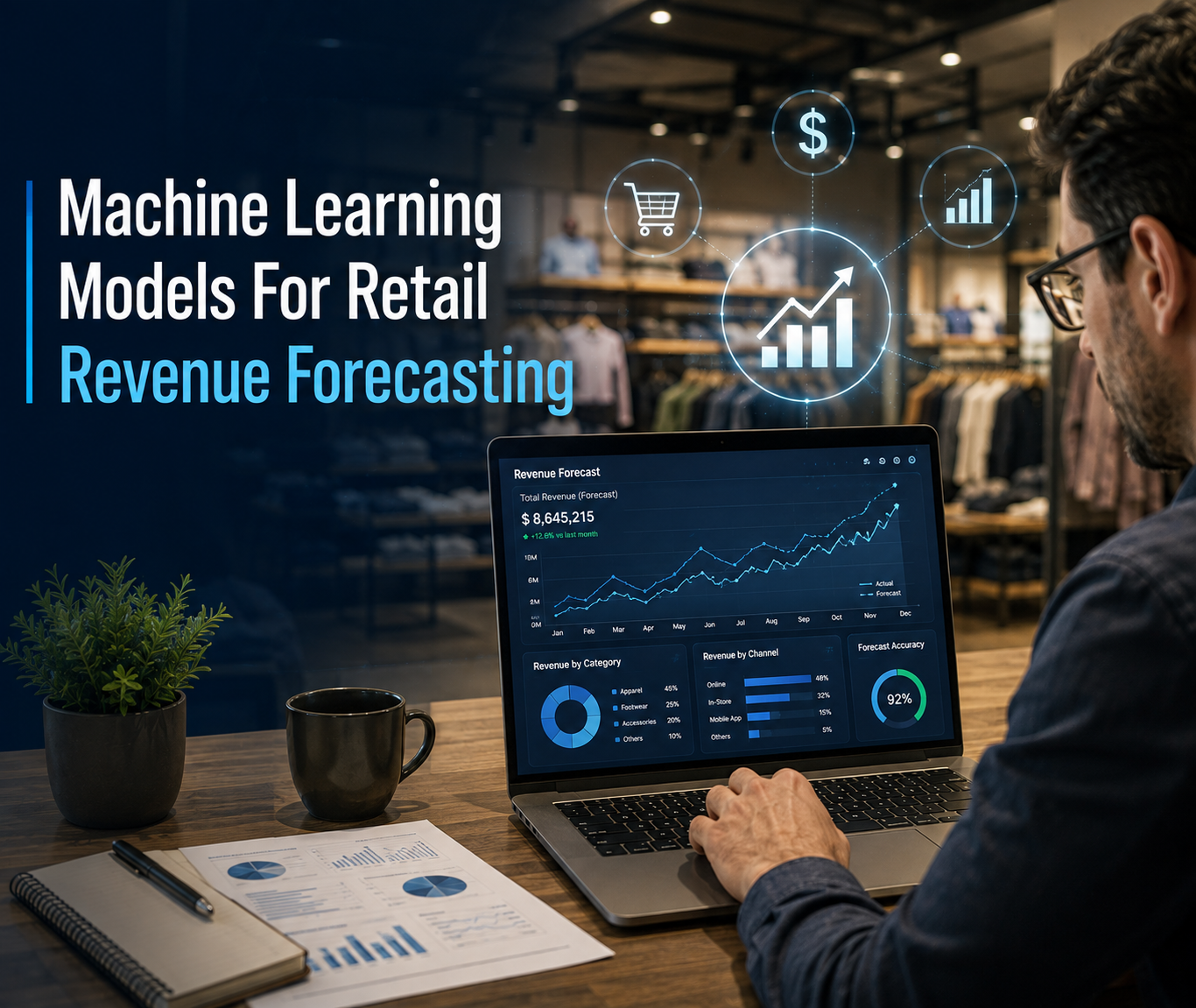
Machine Learning For Retail Revenue Forecasting empowers merchants to anticipate fluctuations, align inventory, and allocate resources with unprecedented confidence across every sales channel, while conventional approaches depend heavily on linear projections that fail during disruptions whether seasonal spikes or sudden economic shifts. ML adapts continuously, ingesting fresh information to refine its outlook without human recalibration.
Retail Revenue Forecasting
Why Traditional Forecasting Falls Short?
Legacy techniques like moving averages and exponential smoothing offer simplicity but cannot handle multidimensional variables simultaneously, as they overlook external factors—weather patterns, competitor promotions, social media sentiment—that materially influence purchasing behavior and consequently leave retailers overstocked or underprepared, suffering margins unnecessarily.
ML Architectures For Revenue Prediction
Several algorithmic families excel at extracting signals from noisy sales data, each bringing distinctive strengths to forecasting challenges where supervised learning dominates this domain by training on historical records paired with known outcomes to generalize future patterns effectively. Machine Learning For Retail Revenue Forecasting typically employs ensemble methods, neural networks, and gradient boosting to achieve superior performance across diverse retail scenarios and data volumes.

ARIMA and Prophet
Statistical frameworks designed explicitly for chronological data remain foundational, capturing seasonality, trends, and cyclic behaviors inherent to retail calendars while Facebook’s Prophet handles missing observations gracefully and ARIMA excels with stationary sequences requiring differencing transformations.
Gradient Boosting Machines
XGBoost, LightGBM, and CatBoost dominate competitions for good reason, efficiently handling mixed data types and missing values without extensive preprocessing while their tree-based architecture captures nonlinear interactions between promotional calendars, pricing changes, and holiday effects automatically, delivering robust predictions even when relationships between variables remain opaque to human analysts.
Deep Learning Approaches
Neural networks, particularly Long Short-Term Memory (LSTM) architectures, prove invaluable for lengthy sequences where distant past events influence current outcomes by memorizing patterns spanning hundreds of days and identifying subtle dependencies that simpler models overlook entirely, yet their appetite for vast datasets and computational resources restricts adoption to larger enterprises with mature data infrastructures.

Data Preparation and Quality Assurance
Garbage in, garbage out remains an immutable law, making data cleansing the most critical phase of any forecasting initiative where missing values require thoughtful imputation, outliers demand careful scrutiny, and inconsistent formats must be standardized before training commences through automated pipelines that handle routine cleaning while domain expertise remains essential for judging anomalous entries.
Model Selection And Validation Strategies
Choosing the right algorithm involves tradeoffs between interpretability, speed, and accuracy that vary according to business requirements, with cross-validation techniques particularly time-series splits respecting chronological order providing honest performance estimates without data leakage while walk-forward validation simulates real deployment conditions exposing weaknesses before models go live. Hyperparameter tuning optimizes each candidate through systematic grid or Bayesian searches extracting maximum capability from chosen architectures.
Integration With Existing Systems
Forecasting engines deliver minimal value if isolated from operational workflows, requiring seamless connectivity with ERP, POS, and supply chain platforms through APIs that facilitate real-time data exchange enabling predictions to update automatically as new transactions occur throughout each trading day, while embedded dashboards present current outlooks alongside historical comparisons empowering rapid tactical adjustments.

Interpretability And Business Trust
Black-box predictions generate skepticism among executives accustomed to transparent spreadsheets, necessitating explainability tools like SHAP values and LIME frameworks that decompose outputs attributing contributions to specific features such as promotions or competitor pricing, while visual dashboards further demystify complex models presenting insights in accessible formats for non-technical stakeholders.
Conclusion
Accurate revenue forecasting no longer remains an aspirational goal but an achievable reality through Machine Learning For Retail Revenue Forecasting, as retailers who adopt these methodologies gain clarity amid uncertainty navigating market turbulence with confidence and precision while the transition demands investment in talent, infrastructure, and cultural change.