
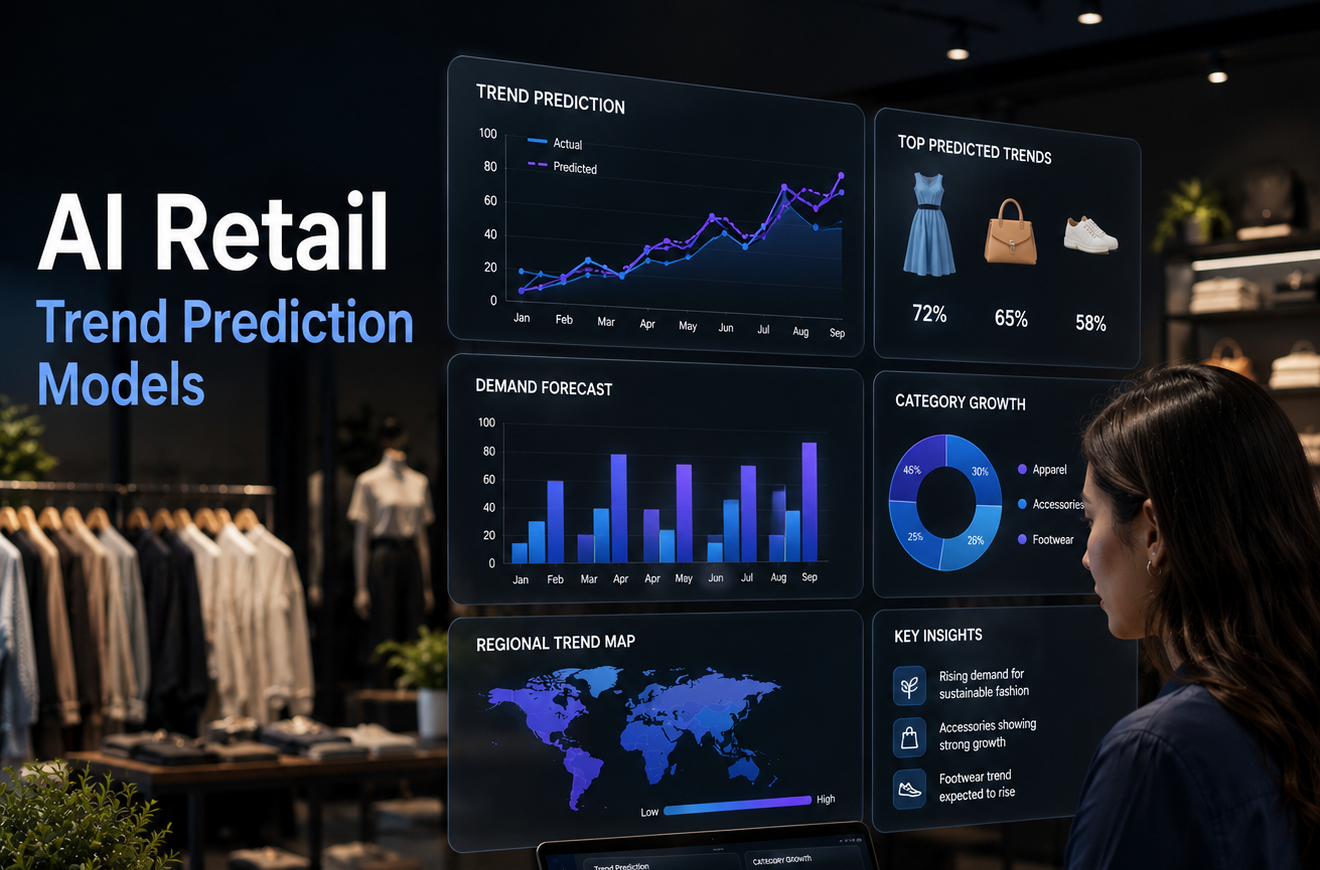
Retailers operate within an ecosystem defined by rapid shifts, where consumer preferences transform overnight, and competitive landscapes rearrange without warning, yet traditional forecasting methods reliant on historical averages and managerial intuition prove increasingly inadequate against this backdrop of constant flux. Artificial Intelligence introduces a paradigm shift, enabling merchants to detect emerging patterns before they become mainstream, thereby securing first-mover advantages across product development, inventory planning, and promotional strategies. Powered by AI, which digests massive datasets, transforming guesswork into strategic certainty.
Retail Trend Prediction Models
Machine Learning Architectures For Trend Detection
Several algorithmic families excel at extracting predictive signals from noisy retail environments, each offering distinctive advantages depending on data characteristics and business objectives, with supervised learning dominating classification tasks by training on labeled historical examples to recognize patterns associated with successful product categories or promotional campaigns, revealing unexpected affinities that inspire innovative merchandising strategies. Leverage these diverse methodologies to capture the full spectrum of consumer behavior dynamics.
Neural Networks and Deep Learning
Deep architectures, particularly convolutional and recurrent networks, demonstrate exceptional aptitude for processing sequential and spatial data inherent to retail operations, modeling complex nonlinear relationships between countless variables and capturing interactions that simpler models cannot represent adequately, whilst their capacity to handle image data further enables visual trend analysis by examining fashion runways, street style photography, and social media imagery to forecast aesthetic directions with impressive accuracy.

Gradient Boosting Ensembles
XGBoost, LightGBM, and CatBoost consistently outperform alternatives across structured datasets, efficiently managing mixed variable types and missing observations without extensive preprocessing, whilst their tree-based foundations capture feature interactions automatically, discovering how promotional calendars, competitor pricing, and holiday schedules combine to influence consumer behavior, making them frequently employ these ensembles as foundational components, leveraging their interpretability alongside predictive power.
Natural Language Processing Applications
Textual data represents an underutilized goldmine, containing opinions, aspirations, and grievances expressed across reviews, forums, and social platforms, where NLP techniques extract semantic meaning, identifying emerging terminology, shifting sentiment, and novel product mentions that signal rising interest categories, whilst this textual intelligence complements numerical forecasts, providing qualitative context that enriches quantitative projections substantially

Feature Engineering for Trend Forecasting
Raw sales figures alone prove insufficient for accurate trend anticipation, necessitating creative construction of derived variables that capture underlying market drivers, including external datasets—economic indicators, weather forecasts, cultural event calendars, and influencer activity logs—that contribute meaningful signals when appropriately encoded, whilst thriving on diverse feature sets that expose relationships invisible to narrower analytical frameworks. Enable localization of trend predictions according to regional preferences and cultural nuances.
Real-Time Data Integration
Static batch processing cannot satisfy modern retail demands, where opportunities emerge and dissolve within compressed timeframes measured in hours rather than weeks, yet streaming architectures enable continuous ingestion from point-of-sale terminals, e-commerce platforms, and social feeds, activating alerts when specific thresholds cross- sudden mention spikes- thus converting prediction from an academic exercise into an operational imperative.
Visual Trend Analysis Through Computer Vision
Consumer electronics categories increasingly benefit from image-based analytics that examine visual elements driving consumer appeal, where computer vision algorithms decompose product imagery into constituent attributes—color palettes, silhouettes, textures, and social postings while incorporating visual features to forecast aesthetic directions months before they appear in mainstream retail channels. Runway shows and street style photography thereby guide assortment planning and ensure merchandise portfolios align with forthcoming aesthetic sensibilities.

Inventory Optimization Through Trend Projections
Accurate trend forecasts translate directly into inventory decisions, determining which products to stock, in what quantities, and across which locations, whilst guiding purchasing commitments, balancing upside opportunities against downside risks with quantitative rigor, reducing working capital requirements while simultaneously improving in-stock positions for high-demand items. Seasonal rollouts benefit particularly from trend intelligence, and markdown schedules based on anticipated consumer response patterns, thereby contributing directly to bottom-line performance.
Ethical Considerations and Responsible AI
Deploying predictive technologies carries obligations beyond commercial objectives, requiring attention to privacy, fairness, and transparency throughout development and operation, as it must respect consumer data rights, implementing anonymization, consent mechanisms, and deletion protocols that honor individual preferences, whilst trust forms the foundation upon which sustainable data relationships rest. Algorithmic bias presents another significant concern, thus, safeguarding brand reputation while ensuring equitable treatment across diverse customer populations.
Measuring Prediction Success
Evaluating forecasting performance demands multidimensional assessment beyond simple accuracy metrics, encompassing business impact and operational outcomes, where it should be judged on inventory productivity improvements, markdown reductions, and sell-through acceleration alongside traditional error measures, as these commercial indicators ultimately determine model value. Bias and variance decomposition provide technical insight, ensuring sustained performance as underlying patterns evolve.
Conclusion
Retail’s future belongs to organizations that master trend anticipation, converting uncertainty into strategic advantage through AI foresight, as it represents the vanguard of this transformation, equipping merchants with capabilities to navigate volatility confidently. Those who invest in these technologies today will define tomorrow’s retail landscape, as hesitant competitors risk irrelevance in an increasingly predictive industry.