
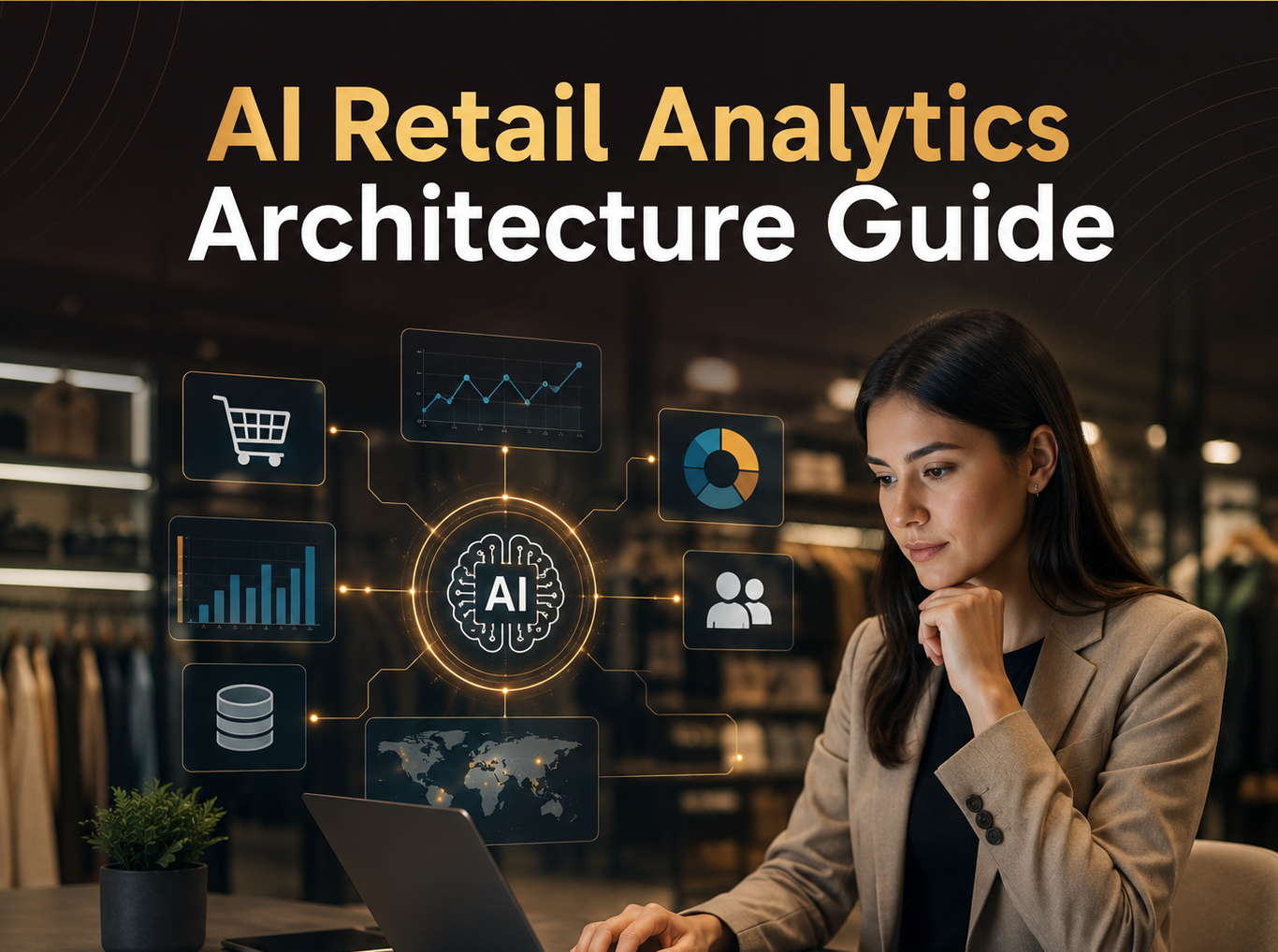
Retail businesses generate information across ecommerce platforms, stores, mobile applications, warehouses, loyalty programs, advertising channels, suppliers, and customer service systems. Retailers need an architecture that can collect information reliably, organize it consistently, process it efficiently, and make trusted insights available to the right teams. Artificial intelligence adds another layer by helping businesses forecast demand, understand customer behavior, detect unusual activity, optimize decisions, and identify opportunities. A well-designed Retail Analytics Architecture creates the foundation for these capabilities while keeping performance, governance, security, and scalability in balance.
Retail Analytics Architecture
Retail Analytics Architecture Layers
Retail Data Sources
A strong analytical foundation begins with a clear understanding of where information originates. Common sources include point-of-sale transactions, ecommerce orders, product catalogs, inventory systems, warehouse platforms, supplier feeds, customer profiles, loyalty activity, returns, promotions, advertising platforms, website events, mobile applications, and support interactions. Retailers should document each source, identify its owner, understand its update frequency, and define which fields have authoritative status. This source inventory helps teams avoid duplicated pipelines and unclear responsibilities.
Data Ingestion And Integration
Data ingestion moves information from operational systems into analytical environments. Batch processing works well for many scheduled datasets, while streaming pipelines can support events that require near-real-time visibility. A retailer may use scheduled loads for financial summaries and event streams for online browsing, inventory changes, or transaction activity. The right approach depends on business urgency, data volume, technical constraints, and cost. Integration processes should also handle schema changes, failed transfers, duplicate events, and late-arriving records. Reliable ingestion matters because downstream models and reports cannot remain trustworthy when the pipeline frequently loses or distorts information.

Data Storage And Organization
Retail analytics environments often use a combination of object storage, data warehouses, and specialized analytical stores. Raw information can remain available for traceability, while curated datasets support reporting and modeling. A well-organized structure separates source records from transformed business-ready information and makes retention policies easier to manage. Partitioning, indexing, compression, and lifecycle rules can improve performance and control infrastructure costs. Shared, well-documented structures make future analytical projects faster and reduce conflicting versions of important metrics.
Data Transformation And Quality
Transformation processes standardize formats, resolve identifiers, handle missing fields, remove duplicates, and create useful business attributes. Quality checks can verify record counts, field ranges, relationships, and freshness before information reaches critical reporting layers. Machine learning can complement these controls by identifying unusual patterns that fixed rules may miss. Retailers should record transformation logic and maintain clear lineage so teams can understand where a metric originated. Reliable preparation improves both everyday reporting and the performance of AI models.
Machine Learning Layer
The machine learning layer turns prepared information into predictions, classifications, recommendations, and other analytical outputs. Retail use cases can include demand forecasting, customer segmentation, churn prediction, price optimization, product recommendations, inventory risk detection, and promotion analysis. The architecture should support experimentation without allowing untested models to influence critical business processes automatically. Version control, model documentation, validation, and performance tracking are important parts of a dependable analytical environment.

Generative AI In Retail Analytics
Generative AI can make analytical systems easier for business users to interact with. Instead of navigating multiple reports, a manager may ask a natural-language question about sales performance, inventory movement, or customer behavior and receive a structured explanation. Generative systems can also summarize trends, create draft narratives, assist analysts with queries, and help teams explore possible causes of performance changes. These tools should connect to trusted data sources and apply appropriate access controls. A fluent answer does not guarantee correctness, so the architecture should provide traceability, source context, and validation for important decisions.
Real-Time Retail Analytics
Some retail decisions benefit from information that arrives within seconds or minutes rather than hours. Real-time analytics can support inventory availability, fraud monitoring, online personalization, campaign response, operational alerts, and customer service. Event streaming platforms can capture activities as they happen and deliver them to processing services or analytical applications. Retailers should reserve streaming architecture for situations where faster information materially improves the decision or customer experience.

Product And Merchandising Analytics
Analytics architecture should connect product attributes with sales, inventory, pricing, promotions, customer interactions, and supplier information. This relationship enables teams to understand which products drive revenue, which items move slowly, where demand differs by location, and which combinations encourage larger baskets. Machine learning can build on these relationships to improve recommendations, assortment planning, and forecasting. A consistent product identifier is especially important because mismatched product records can fragment analysis and produce misleading results.
Inventory And Supply Chain Analytics
Inventory analytics depends on timely information from stores, warehouses, suppliers, fulfillment systems, and sales channels. An integrated architecture can help retailers monitor stock levels, replenishment activity, transfers, purchase orders, delivery status, and demand signals. Predictive models can estimate future requirements and identify locations where stock may become constrained or excessive. The architecture should distinguish between physical quantities, available-to-promise stock, reserved units, and other business concepts so teams do not confuse different measures. Accurate supply-chain information can improve availability while reducing unnecessary working capital.

Analytics For Pricing and Promotions
Pricing and promotion decisions require a combination of historical performance, customer response, product characteristics, inventory conditions, competitive information, and business rules. A flexible architecture can bring these inputs together for analytical models and scenario analysis. Retailers can evaluate whether a promotion generates incremental demand, shifts purchases between products, or reduces margin without sufficient benefit. Pricing models should remain transparent enough for commercial teams to understand the main drivers behind recommendations. Clear controls can also prevent automated actions from violating brand, contractual, or regulatory requirements.
Data Governance And Security
Retailers should define ownership, access permissions, retention requirements, data classifications, quality standards, lineage, and audit processes. Sensitive customer information deserves stronger controls, including appropriate encryption and restricted access. Governance should not become so complicated that teams avoid using the platform. Strong governance also makes AI adoption safer because teams can understand which information models may use and how outputs should be handled.

Architecture For Scalability
Retail data volumes can grow rapidly during promotions, seasonal events, new market launches, or business expansion. A scalable architecture should handle higher transaction counts, more customers, additional stores, larger product catalogs, and increasingly complex models without requiring a complete redesign. Scalability also involves organizational growth. Shared standards, reusable pipelines, and modular services allow new teams and use cases to join the environment without creating disconnected systems.
Model Monitoring And Responsible AI
Machine learning models can lose effectiveness as customer behavior, product ranges, pricing policies, and market conditions change. Model monitoring should track prediction quality, data drift, feature changes, latency, and unusual output patterns. A model that performs well during testing may behave differently after deployment. Regular evaluation and controlled retraining can help maintain quality. Responsible AI should be built into the architecture rather than added after a model reaches production.
Conclusion
An effective Retail Analytics Architecture gives retailers a dependable foundation for turning complex information into practical decisions. AI can then build on that foundation to improve forecasting, personalization, inventory planning, pricing, customer understanding, and operational responsiveness. It is the design that meets current business needs, scales as requirements grow, protects sensitive information, and allows teams to trust the insights they receive. By building around reliable data and measurable decisions, retailers can create an analytics environment that supports sustainable innovation.