
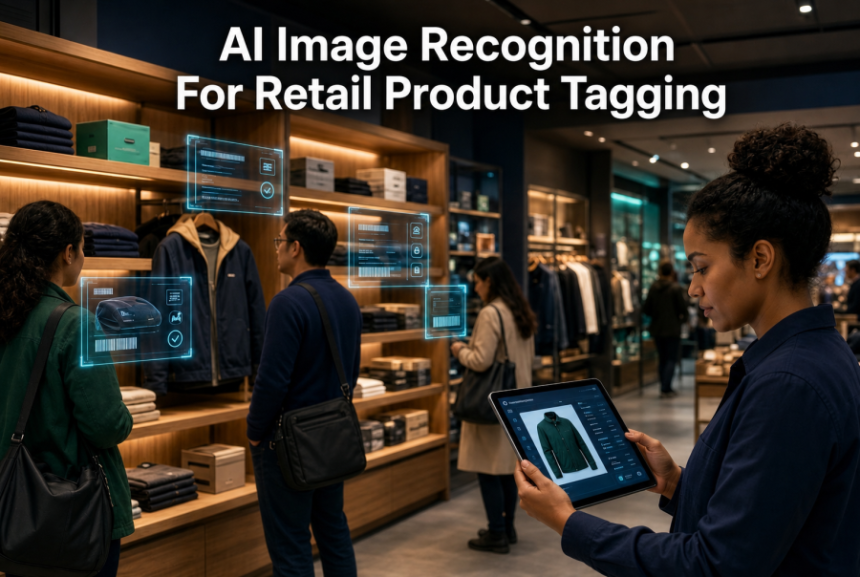
Online retailers depend on accurate product information to help shoppers find what they need. Product photos are an important part of that information, but adding useful tags to thousands of images can take a great deal of manual effort. AI image recognition offers a practical solution. AI Image For Retail Product Tagging can examine product photographs, identify visual characteristics, and suggest relevant labels with speed and consistency. This allows retail teams to spend less time on repetitive catalog work and more time improving the customer experience.
AI Image Recognition for Retail
How AI Image For Retail Product Tagging Works?
An image recognition system receives a product photograph and converts its visual information into features that a trained model can interpret. The model compares those features with patterns learned from AI Image Recognition for Retail labeled examples. Depending on the use case, it may identify the main product, detect several objects, recognize colors, or assign style-related attributes. The resulting tags can include broad categories and specific characteristics. Confidence scores can help determine which suggestions are ready for use and which ones need review.
Identifying Product Attributes
Retail images contain many details that can be useful for discovery. AI can help identify attributes such as color, sleeve length, product shape, material appearance, pattern, footwear type, furniture style, or accessory category. The exact attributes depend on the retailer’s catalog. A fashion store may focus on neckline, color, and silhouette, while a furniture business may care more about form, finish, and seating type. Defining relevant attributes before deployment helps keep the tagging system focused.
Supporting Personalized Recommendations
Recommendation systems need meaningful product information to make useful connections. Visual tags can help identify similarities between items even when their written descriptions are different. A shopper viewing a minimalist lamp, Image-derived attributes add another source of information that can complement customer behavior and text-based product data.
Reducing Catalog Inconsistency
Large retail catalogs often contain products from many suppliers. One supplier may describe a color as navy while another uses dark blue. Similar differences can appear in style, product type, and other attributes. AI-generated tags can provide a more consistent vocabulary when they are mapped to a controlled set of labels. Human review can then be used for cases where the model is uncertain or where a business-specific term is required.
Training Data and Model Quality
Image recognition models learn from examples, so training data has a direct effect on performance. Images should represent the products, styles, backgrounds, and variations that the retailer expects to process. Poor labels can teach the model incorrect associations, while a narrow dataset may perform badly on unfamiliar products. Retailers should regularly evaluate accuracy across important categories and update training data as the assortment changes

Practical Implementation Approach
The team can define the attributes that matter, prepare representative images, and create reliable labeled examples. After testing the model, high-confidence tags can be automated while uncertain cases go to a reviewer. Performance can be measured using tagging accuracy, correction rates, processing time, and improvements in product discovery. Once the workflow is stable, it can be extended to additional categories.
Benefits
AI tagging can reduce repetitive work, improve catalog consistency, and speed up product publishing. It can also give customers better ways to discover products through search and filtering. For merchandising teams, structured visual data can make it easier to build collections and identify related products. The value comes from turning product photographs into usable information rather than treating images as static content.
Future of AI Image Recognition
Computer vision is moving beyond simple object identification. Modern multimodal systems can combine images with product descriptions and other catalog information to create a richer understanding of each item. Future retail tools may automatically generate tags, write image descriptions, detect missing attributes, and identify visual similarities across an assortment. Human oversight will remain valuable when product information affects customer expectations or business decisions.
Conclusion
AI Image For Retail Product Tagging can help retailers turn product photographs into structured, useful catalog information. By recognizing visual features and assigning relevant labels, AI can improve search, filtering, recommendations, merchandising, and catalog maintenance. The strongest results come from quality training data, clear tagging standards, confidence-based automation, and human review. Used thoughtfully, image recognition can reduce repetitive work while making product discovery more accurate and convenient for shoppers.