
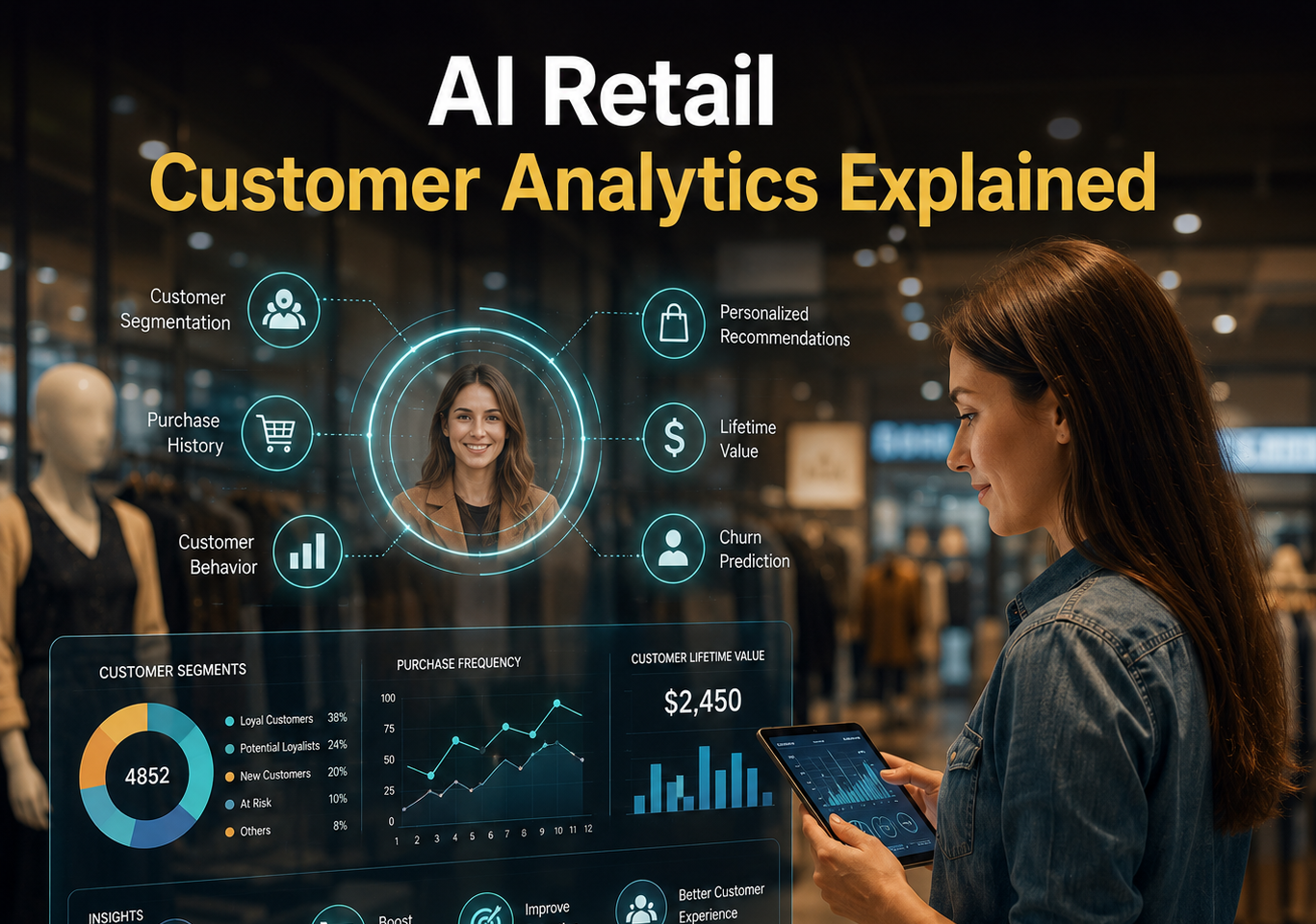
Retailers generate customer information through purchases, searches, loyalty programs, product reviews, service conversations, website visits, mobile activity, and store interactions. The challenge lies in turning these signals into useful commercial understanding. Artificial intelligence can connect diverse records, identify patterns, predict likely behavior, and surface opportunities that manual reporting may overlook. Retail Customer Analytics gives businesses a structured way to understand shoppers and improve decisions across marketing, merchandising, product discovery, service, pricing, and retention. When AI strengthens that capability, customer analysis can move from periodic reporting toward continuous, actionable intelligence.
AI Retail Customer Analytics
Creating A Unified Customer View
Customer information often sits across ecommerce platforms, point-of-sale systems, loyalty databases, applications, customer service tools, and marketing platforms. A fragmented view can make the same person appear as several unrelated records or hide important interactions between channels. Retailers can create a more reliable customer profile by establishing consistent identifiers, data definitions, consent rules, and integration processes. Better connectivity gives AI models a stronger foundation and helps teams interpret behavior in context.
Personalization At Scale
Effective personalization goes beyond adding a shopper’s name to an email. AI can select products, content, offers, recommendations, and communication timing according to observed behavior and context. A returning customer may receive suggestions related to previous interests, while a new visitor may see recommendations based on current activity and product relationships. Personalization should create genuine convenience or relevance. Excessive targeting can reduce trust, so retailers should manage frequency, respect customer preferences, and maintain clear privacy practices.
Understanding Purchase Behavior
A purchase can reflect many factors, including product relevance, price, convenience, timing, brand preference, urgency, or promotional influence. AI can analyze sequences of transactions to identify recurring combinations, purchase intervals, category relationships, and shifts in preference. These findings can improve assortment planning, cross-selling, recommendations, and replenishment strategies. Retailers should interpret behavioral correlations carefully because a statistical relationship does not automatically prove customer intent. Context, testing, and human review can help distinguish useful signals from misleading patterns.
Product Recommendations And Discovery
Large retail catalogs can make product discovery difficult when shoppers must browse thousands of options. AI recommendation systems can rank relevant products using purchase history, browsing behavior, product attributes, similarity, and context. Search models can also interpret natural-language queries and improve result relevance. Retailers can measure success through conversion, engagement, incremental value, and customer satisfaction rather than relying on clicks alone.
Churn Prediction And Retention
A decline in engagement can provide an early signal that a customer may become inactive. Churn models can help retailers prioritize appropriate retention actions, including service recovery, useful reminders, or relevant recommendations. The objective should be to improve the relationship rather than send discounts indiscriminately. Retention strategies become more effective when they address the reason behind declining engagement.
Pricing And Promotion Insights
Customers respond differently to price changes and promotions depending on category, channel, timing, and individual preferences. Machine learning can estimate likely responses and help teams compare promotional scenarios. Models can incorporate historical behavior, price sensitivity, inventory position, competitor signals, and campaign context where appropriate. Retailers should also consider whether a promotion creates genuinely incremental demand or simply shifts a purchase that would have occurred without the discount.

Customer Analytics For Merchandising
Merchandising teams can use customer analytics to understand which products attract attention, which items frequently appear together, and how preferences vary across locations or channels. AI can connect these patterns with product attributes, price points, seasonality, and availability. The resulting intelligence can support assortment planning, product placement, category strategy, and new-product evaluation. Customer evidence can help retailers build more.
Real-Time Customer Signals
Customer behavior can shift rapidly during product launches, promotions, service incidents, or unexpected market events. AI systems can monitor searches, orders, engagement, reviews, and support activity to detect unusual changes. Early awareness can help teams investigate developing issues while they remain manageable. However, every fluctuation does not require immediate intervention. Appropriate thresholds and validation steps can prevent teams from reacting to temporary noise and help them concentrate on changes.

Omnichannel Customer Intelligence
Modern shoppers move between stores, websites, applications, marketplaces, social platforms, and service channels. AI can connect these interactions to create a more complete picture of the customer journey. Retailers should avoid assuming that the channel recording the final transaction created all the value. Omnichannel intelligence supports better decisions about inventory, marketing, service, and experience design.
Data Quality And Governance
Duplicate profiles, missing transactions, inconsistent product identifiers, stale records, and delayed events can create misleading conclusions. Retailers should establish validation rules, shared definitions, clear ownership, data lineage, and monitoring routines. Identity resolution deserves particular attention because incorrect matching can combine information from different people. Reliable governance makes analytical findings easier to interpret and gives teams greater confidence when they use predictions for commercial decisions.
Conclusion
Retail Customer Analytics becomes more valuable when businesses connect accurate information with predictive models, natural-language analysis, responsible personalization, and practical workflows. The objective is not to automate every customer decision. It is to help teams understand shoppers more effectively and respond with greater relevance. Retailers that combine analytical intelligence with strong governance and human judgment can create better experiences while improving measurable commercial performance.