
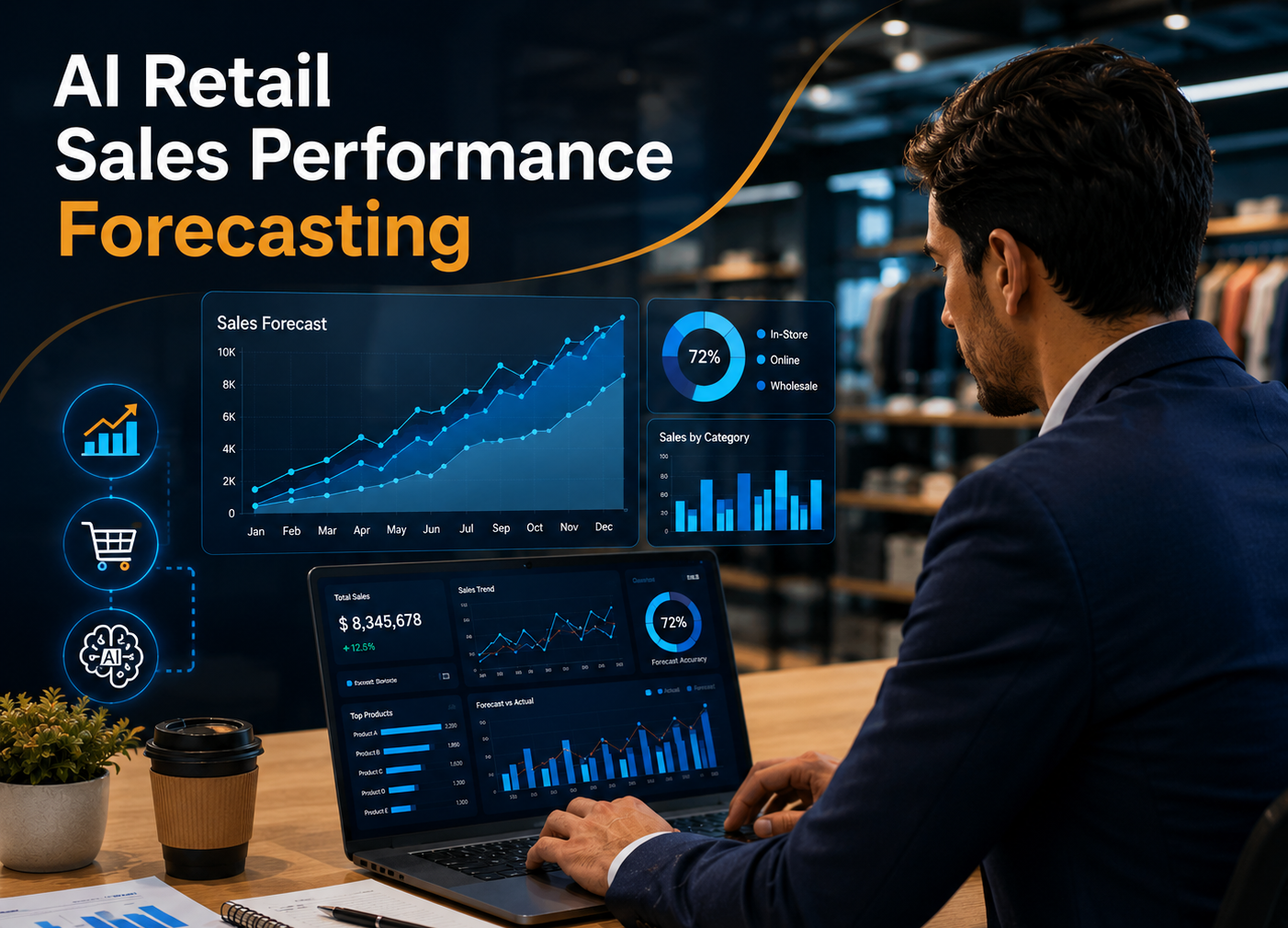
Retail businesses operate in a fast-changing environment where customer preferences, seasonal demand, pricing, promotions, and market conditions can shift quickly. Relying only on historical reports or assumptions is no longer enough to plan effectively. AI Retail Sales Performance Forecasting helps businesses estimate future sales by analyzing large volumes of data, identifying meaningful patterns, and highlighting changes in buying behavior. These insights support better planning for inventory, staffing, marketing, and revenue growth. For a modern AI development company, intelligent forecasting solutions offer retailers a practical way to turn business data into informed decisions.
AI Retail Sales Performance
Why Retail Businesses Need AI for Sales Forecasting?
Retailers generate large amounts of valuable information through point-of-sale systems, websites, mobile applications, loyalty programs, inventory platforms, customer service channels, and digital marketing activity, but turning that information into useful insight can be challenging. AI can process complex datasets quickly and identify relationships that conventional reporting may overlook. A forecasting model may recognize how pricing changes, promotions, local events, weather, customer trends, and product availability together influence sales. This makes Retail Sales Performance Forecasting more responsive and useful for planning because businesses can identify possible changes earlier rather than waiting until performance reports show that a problem or opportunity has already occurred.

How AI Retail Sales Performance Works ?
AI forecasting starts by collecting relevant information such as historical sales, product details, inventory levels, pricing history, promotions, customer purchasing behavior, location data, seasonal influences, and online activity. The information is then cleaned and organized to reduce duplicate records, inconsistent values, and missing details before machine learning models examine it for recurring relationships and unusual changes. After learning from the available data, the system produces estimates for future periods and can generate predictions at different levels of the business. Actual outcomes can then be compared with predicted results, allowing the model to be monitored and refined as new information becomes available and market conditions evolve.
Analyzing Historical Sales Patterns
AI can examine previous sales cycles, weekly and monthly movement, seasonal peaks, promotional periods, regional differences, and product-level behavior to identify recurring patterns. Advanced models can also separate normal fluctuations from unusual activity, helping retailers avoid making decisions based only on simple averages. By understanding the context behind earlier results, businesses can create a stronger starting point for future estimates and identify which products have stable demand and which require closer monitoring because their sales patterns change more frequently.
Using Real-Time Business Signals
Historical information is valuable, but it may not be enough when customer behavior changes quickly. AI can incorporate current signals such as website traffic, product searches, product views, cart activity, order trends, promotional responses, store transactions, and other available indicators. When these signals begin to change, forecasting models can detect movement that may indicate an upcoming increase or decline in sales. Earlier recognition gives retail teams more time to review purchasing, inventory allocation, marketing activity, and fulfillment plans, making the forecasting process more adaptive than relying on reports created only at fixed weekly or monthly intervals.

Detecting Sudden Sales Shifts
A product may suddenly become popular because of social media attention, influencer recommendations, viral content, competitor shortages, changing trends, or an unexpected event, while another item may decline because customer preferences have shifted. AI can monitor sales and engagement patterns to identify unusual movement quickly and compare current results with expected behavior. When performance begins to deviate significantly, retailers can investigate the possible cause and determine whether purchasing, pricing, inventory allocation, or marketing activity should be adjusted before the change has a larger operational or financial impact.
Improving Inventory Planning
Sales forecasts directly influence inventory decisions because retailers need enough merchandise to satisfy customers without purchasing excessive quantities that may remain unsold. AI can combine expected demand with current stock, supplier lead times, replenishment schedules, product movement, and sales patterns to support more informed planning. This approach can improve product availability while reducing unnecessary storage costs and helping purchasing teams make decisions based on a broader view of expected business performance.
AI and Customer Behavior Analysis
Customer behavior provides valuable signals for understanding future sales movement. AI can analyze browsing activity, purchase history, product searches, cart behavior, repeat orders, loyalty information, and digital engagement patterns to identify changes in customer interest. These signals can reveal early indications of emerging preferences before they become fully visible in completed transactions. When behavioral information is combined with sales, inventory, and market data, forecasting can become more responsive to changing customer needs and help retailers plan products, promotions, and availability with greater confidence.

Role
An experienced AI development company can help retailers build customized forecasting solutions that match their operational requirements and business goals. This may involve assessing available information, connecting sales and inventory systems, creating data pipelines, developing and testing machine learning models, building reporting dashboards, and integrating predictions with existing workflows. A technology partner can also monitor model performance and improve the solution as products, customer behavior, and market conditions change. A customized approach is valuable because retailers differ in their customers, locations, sales channels, product ranges, and planning challenges, making a generic forecasting system less suitable for every business.
AI Technologies Used in Retail Forecasting
Machine learning is widely used to identify relationships in historical information and estimate future results, while deep learning can support more complex datasets with many interacting variables. Predictive analytics helps organizations evaluate likely outcomes based on current and previous information, and natural language processing can examine customer reviews, feedback, or text-based signals that may reveal changing preferences. Real-time analytics can process incoming information quickly and support frequent forecast updates when important conditions change. The right technology depends on the retailer’s data, business goals, operational complexity, and the level of detail required from the forecasting solution.
Data Sources for Retail Sales Performance Forecasting
Effective forecasting depends on reliable information from multiple sources. Historical transactions reveal patterns in sales volume and revenue, while customer data provides insight into purchase frequency, preferences, and shopping behavior. Inventory records help distinguish low demand from lost sales caused by unavailable products, and pricing and promotion data shows how commercial activity influences buying decisions. Seasonal events, holidays, regional conditions, competitor activity, and digital engagement such as website visits, product searches, and abandoned carts can provide additional signals. An AI development company can help connect these sources into a unified environment that supports stronger analysis and model development.

Benefits
AI forecasting can improve planning across several retail functions by providing a clearer view of expected business activity. Better estimates can support healthier inventory levels, reduce the risk of shortages and overstocking, improve purchasing decisions, and help teams prepare for changing sales conditions. Retailers can also evaluate possible outcomes from price changes and promotions, plan staffing according to expected activity, and coordinate supply chain resources more efficiently. Instead of relying only on reports that explain past results, decision-makers gain a forward-looking perspective that helps them identify opportunities and potential risks earlier.
Measuring the Success of AI Forecasting
Retailers should evaluate forecasting solutions through both prediction quality and practical business outcomes. Useful measures can include forecast accuracy, stockout frequency, excess inventory, inventory turnover, sales performance, fulfillment efficiency, purchasing effectiveness, and promotional results. Comparing these measures with previous planning methods can show whether AI is creating measurable improvements. Regular evaluation also helps businesses identify products, locations, or market conditions where models require additional information or refinement, ensuring that the forecasting system continues to support changing operational needs.
Challenges
AI forecasting can be affected by poor data quality, limited historical information, sudden market disruptions, changing customer behavior, and disconnected business systems. A model trained mainly on stable historical conditions may struggle when an unusual event changes purchasing patterns dramatically, while incomplete data can reduce the reliability of predictions. Retailers should therefore combine AI insights with business knowledge and monitor results continuously. Clear data governance, reliable system integration, appropriate model testing, and human oversight are important for maintaining useful forecasting outcomes and ensuring that the technology supports practical business decisions.
Conclusion
AI Retail Sales Performance Forecasting gives retailers a practical way to use business information for stronger planning and decision-making. By analyzing sales history, customer behavior, inventory, pricing, promotions, seasonal patterns, and current business signals, AI can help organizations anticipate demand, improve stock management, support smarter commercial decisions, and prepare for changing market conditions. With support from an experienced AI development company, retailers can develop scalable forecasting solutions that align with their operational needs, improve visibility across the business, and help teams make faster and more confident decisions in a competitive retail environment.