
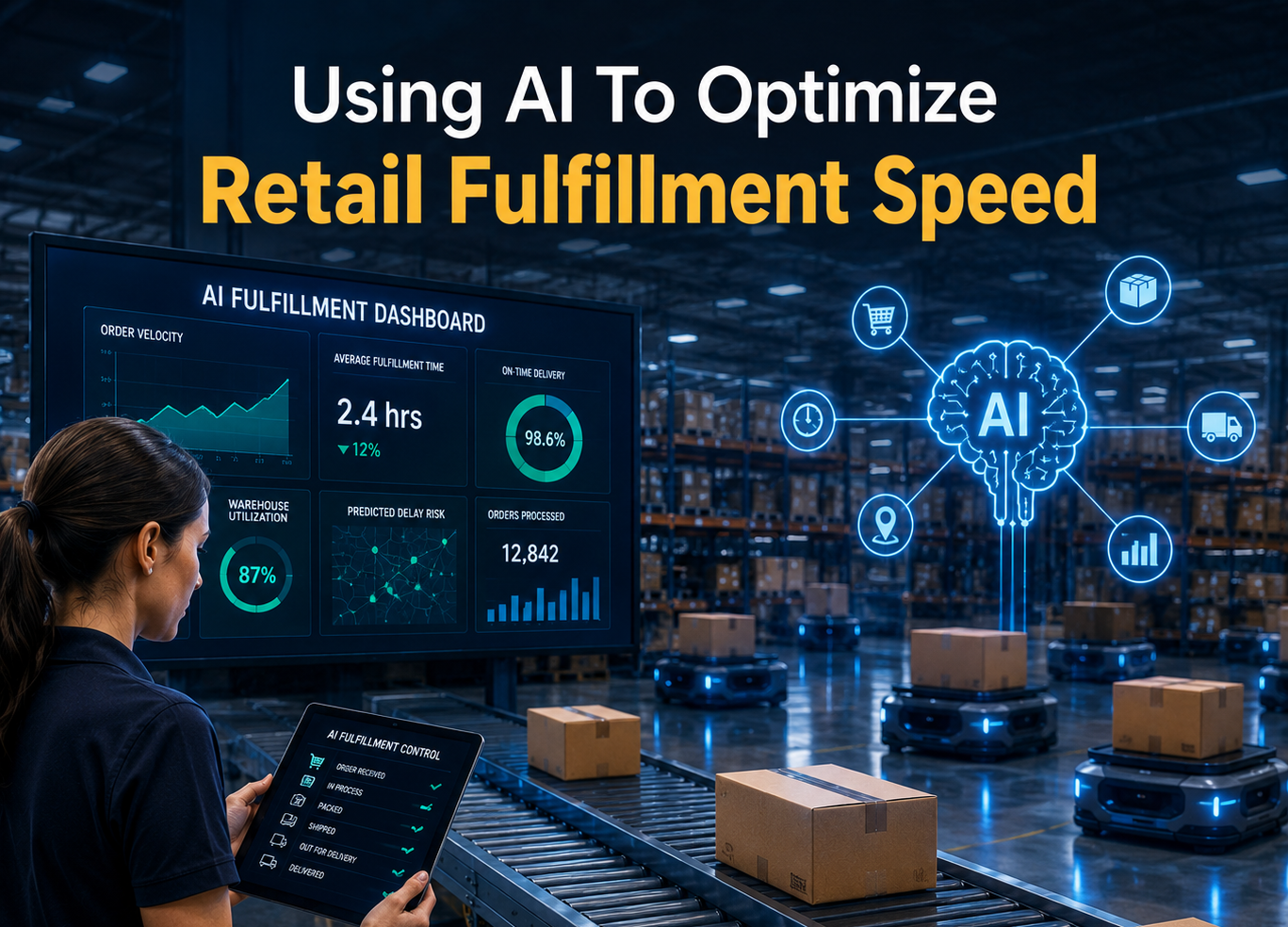
Customers expect retailers to process purchases quickly and provide clear updates throughout the journey. Slow handling can trigger support requests, cancellations, poor reviews, and lost loyalty. Retailers need connected operations that respond to order volume, stock levels, staffing, transport conditions, and shopper expectations. Artificial intelligence helps teams meet that challenge by examining operational data, forecasting demand, assigning work intelligently, and spotting constraints early. When teams apply AI with clear goals, the technology can improve Retail Fulfillment Speed while supporting accuracy, cost discipline, and dependable customer service.
Retail Fulfillment Speed
AI-Powered Order Forecasting
Retailers can use AI to estimate future order volume across stores, warehouses, regions, and time periods. Machine learning can examine these influences together and refresh projections as new information arrives. Better estimates help leaders prepare staffing, workspace, packaging materials, transport capacity, and processing schedules before queues form. Forecasting does not remove uncertainty, but it gives planners a stronger basis for preparing several demand scenarios.
Intelligent Inventory Visibility
AI can compare sales, transfers, returns, replenishment activity, warehouse records, and inventory movements to reveal inconsistencies and improve availability estimates. The technology can also help teams decide where to position popular products according to expected demand and fulfillment needs. Better visibility reduces search time, prevents avoidable order changes, and gives routing systems more confidence when they select a fulfillment point. Accurate inventory information therefore supports both faster processing and more reliable customer promises.
Optimizing Picking And Packing
Picking often consumes substantial warehouse labor, especially when employees must collect products from several areas. Managers can use those insights to place frequently purchased items near suitable processing zones and group compatible orders when the workflow allows it. Packing stations can also use intelligent recommendations for carton selection, item grouping, and workload balancing. These changes can reduce unnecessary walking and waiting while helping employees maintain accuracy.

Smarter Order Allocation
AI can weigh stock availability, workload, labor capacity, distance, carrier schedules, service commitments, and transport conditions before recommending a source. This approach helps operations spread demand across available capacity instead of sending every order through a fixed location. During busy periods, intelligent allocation can protect delivery promises by steering work toward facilities that can complete it efficiently.
Dynamic Workforce Management
Labor capacity directly affects processing performance. AI can compare expected volume with shift schedules, task complexity, historical productivity, absenteeism, and current workload. Managers can then move capacity toward activities that create the greatest delay. Real-time monitoring can also reveal when a station needs additional help. This flexible approach gives supervisors better control than a schedule that remains fixed regardless of changing conditions.
Improving Delivery Partner Selection
The warehouse does not control the entire customer journey. AI can compare these factors when teams choose delivery options for different orders. Instead of selecting a carrier only by price or distance, managers can consider the promised window and historical performance for the relevant area. Ongoing analysis can reveal which partners consistently meet commitments and which circumstances often produce delays. Retailers can use that knowledge to make stronger routing choices and set more realistic promises.
Real-Time Tracking And Exception Management
Accurate visibility helps both customers and operations teams after dispatch. AI can examine tracking events and flag stalled movement, missed scans, unusual transit times, address problems, or repeated delivery attempts. Teams can then contact a carrier, update the shopper, reroute a shipment, or offer another solution before the issue grows. Proactive exception management reduces unnecessary frustration and gives service agents clearer information when they need to intervene. Tracking therefore becomes more than a status page; it becomes an operational tool that supports timely decisions.

Measuring Fulfillment Performance
Retailers need clear measures to understand whether an AI initiative actually improves operations. Useful indicators include order cycle time, picking duration, packing throughput, dispatch punctuality, backlog volume, inventory accuracy, cancellations, delivery exceptions, and the share of orders that meet promised service levels. AI can connect these measures and help teams investigate relationships between operational conditions and customer outcomes. For example, a processing slowdown may coincide with a staffing shortage, unusual order complexity, or delayed replenishment. A balanced measurement framework keeps teams from chasing speed while overlooking accuracy, cost, or service quality.
Reducing Costs Without Sacrificing Speed
Retailers often view speed and cost as competing priorities, yet intelligent planning can improve both. By examining the full order journey, teams can distinguish activities that genuinely improve service from steps that consume resources without adding meaningful value. Better allocation can also shorten product travel distances. The goal should not involve cutting every expense; it should involve designing a process that delivers strong service without creating unnecessary operational spending.

AI for Returns And Reverse Logistics
Returns create another operational journey because teams must receive, inspect, classify, and redirect products. AI can forecast return volume, identify common reasons, prioritize inspection work, and recommend suitable next steps. Teams may restock, repair, repackage, transfer, or redirect an item depending on its condition and demand. Return analysis can also reveal product, sizing, description, or packaging problems that encourage unnecessary purchases and subsequent returns, giving retailers another opportunity to improve the customer journey.
Conclusion
AI gives retailers a practical way to improve fulfillment without treating speed as an isolated warehouse target. Retail Fulfillment Speed improves when faster processing works alongside accurate inventory, sensible costs, realistic promises, and clear communication. Retailers should use AI where it removes friction, anticipates pressure, and supports better decisions rather than automate for its own sake. With reliable data and experienced teams guiding the technology, businesses can create a fulfillment operation that responds quickly to demand and delivers a more dependable experience.