
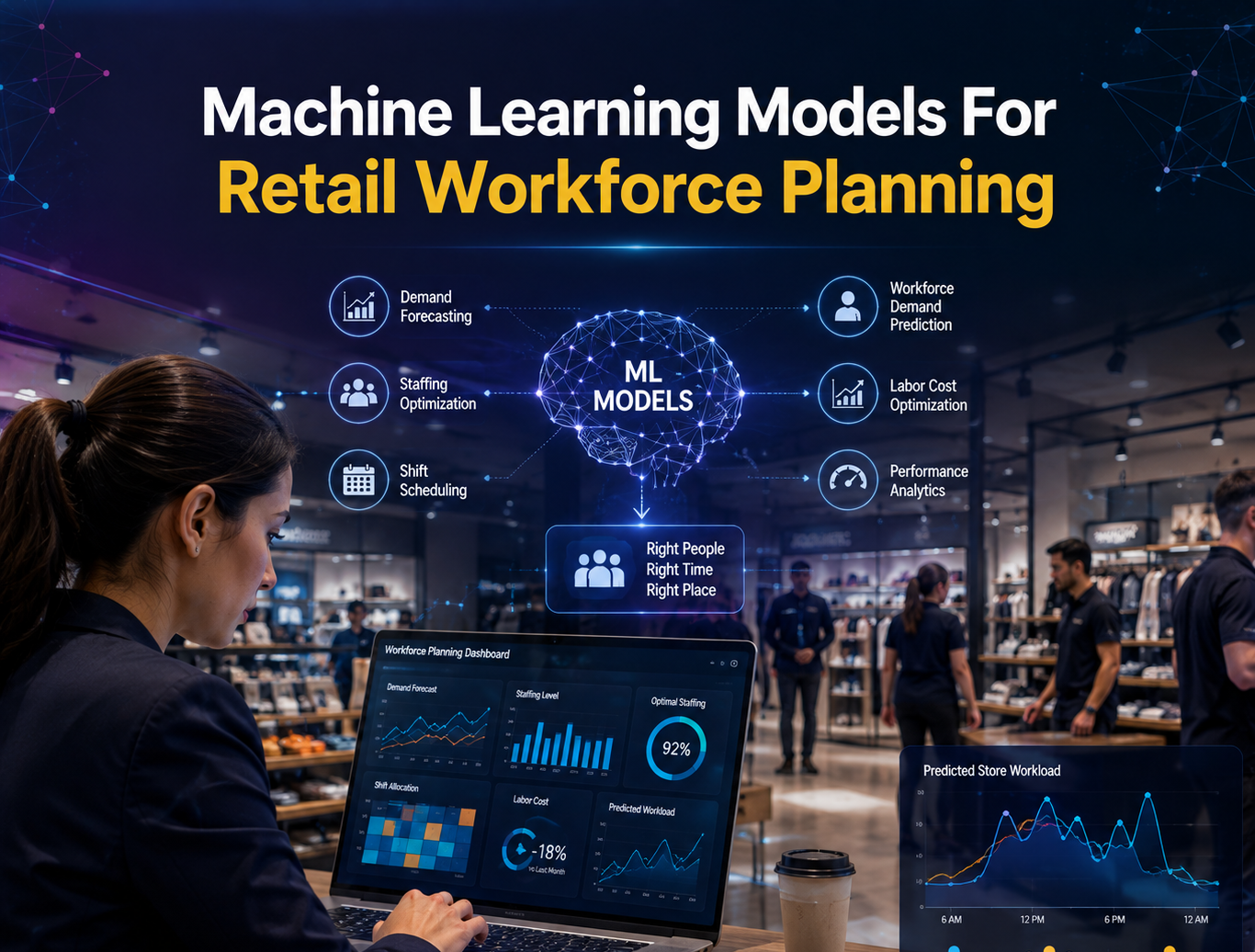
Retail businesses need the right people in the right place at the right time. Customer traffic, online orders, promotions, seasonal demand, and local events can change workloads quickly. Traditional schedules often rely on fixed rules or simple historical averages, which may not reflect current conditions. Machine learning can provide a more flexible approach by analyzing operational patterns and estimating future staffing needs. Effective Retail Workforce Planning can improve service, control labor costs, and help teams respond to changing demand.
Retail Workforce Planning
How Does ML Support Workforce Decisions?
Machine learning models can examine historical sales, transaction volumes, footfall, order activity, staffing records, promotions, and seasonal patterns. From these inputs, models can estimate future demand and identify periods when labor requirements may rise or fall. The resulting forecasts can support scheduling, shift allocation, labor budgeting, and workforce deployment. Rather than replacing managers, these systems provide evidence that helps experienced teams make faster and better-informed choices.
Demand Forecasting For Staffing
Accurate staffing begins with understanding expected demand. Machine learning can forecast sales volumes, customer visits, online orders, or fulfillment workloads using historical and current information. These estimates can be converted into labor requirements based on the work needed to serve customers or process orders.
Matching Skills With Business Needs
Some team members have specialized knowledge in sales, customer support, merchandising, inventory handling, fulfillment, or technical operations. Workforce planning becomes more effective when decisions consider both headcount and the skills required during each period. Machine learning can identify recurring workload patterns and support forecasts for specific roles. This allows retailers to plan coverage based on capability as well as the number of available employees.

Optimizing Employee Scheduling
Scheduling involves more than assigning enough people to a shift. Retailers must consider employee availability, skills, working-hour policies, contractual requirements, and business priorities. Machine learning forecasts can provide a demand estimate, while optimization methods can help create schedules that balance coverage with these constraints. Managers can then review and adjust the proposed plan when necessary. This approach can reduce manual effort while improving alignment between labor resources and operational needs.
Supporting Omnichannel Operations
Retail workforce requirements now extend beyond the sales floor. Employees may support online orders, click-and-collect services, returns, customer inquiries, and warehouse tasks alongside traditional store activities. Machine learning can analyze workloads across channels and identify how demand in one area affects staffing in another. This broader view helps businesses allocate people where they are most needed and avoids planning each channel in isolation.

Store-Level And Regional Planning
Workforce requirements can vary considerably between stores and regions. Customer traffic, store size, product assortment, local events, and shopping habits can create different staffing patterns. A single company-wide rule may therefore produce inaccurate schedules for individual locations. Machine learning can analyze performance at a detailed level and identify location-specific trends. Regional managers can use these insights to develop plans that reflect local conditions while supporting broader business standards.
Improving Labor Cost Management
Labor is a high operating cost, so retailers need to balance service quality with financial efficiency. Overstaffing can increase unnecessary expense, while understaffing may lead to long queues, missed sales, employee pressure, and weaker customer experiences. Machine learning can provide demand-based estimates that help managers understand where labor hours are likely to create the greatest value. These insights support more informed budgeting and resource allocation without relying only on broad cost-cutting targets.

Real-Time Workforce Adjustments
Even a well-designed schedule may need adjustment when unexpected conditions arise. Sudden increases in customer traffic, delivery delays, employee absences, or changes in online order volumes can affect workloads. When current operational information is available, monitoring systems can identify significant deviations from expected patterns. Managers can then review the situation and reassign resources, extend coverage, or adjust priorities. Timely insight makes workforce planning more responsive without removing human control.
Machine Learning Models Used In Workforce Planning
Different machine learning approaches can support different planning tasks. Time-series forecasting models can estimate future sales, traffic, or order volumes. Regression methods can evaluate how multiple factors relate to staffing demand, while classification models can identify patterns associated with high or low workload periods. Clustering can group similar stores, days, or operating conditions. The most suitable approach depends on the available data, planning objective, and accuracy required for the decision.
Measuring Model Performance
Retailers should evaluate workforce models using both technical and business measures. Forecast accuracy can show how closely predicted demand matches actual results, while operational metrics can reveal whether improved forecasts lead to better staffing decisions. Useful indicators include queue times, labor cost, sales per labor hour, task completion, service levels, schedule stability, and manager satisfaction. Measuring several outcomes helps organizations determine whether a model creates practical value.

The Future Of Retail Workforce Planning
Workforce planning is likely to become increasingly connected with real-time demand, inventory activity, omnichannel operations, and employee scheduling systems. AI may provide more adaptive forecasts and allow managers to explore staffing scenarios through conversational interfaces. However, successful adoption will continue to depend on transparency, reliable data, fairness, privacy, and human accountability. Retailers that combine intelligent forecasting with responsible management can create workforce plans that respond to both business needs and employee realities.
Conclusion
Machine learning can make Retail Workforce Planning more accurate, flexible, and responsive by connecting staffing decisions with expected demand and operational conditions. Forecasting models can estimate customer traffic, sales activity, online orders, and workload, while optimization methods can support scheduling under real business constraints. The greatest value comes from combining reliable data, appropriate technology, measurable objectives, and experienced human oversight. When implemented responsibly, machine learning can help retailers improve service, manage labor costs, and prepare their teams for changing demand.