
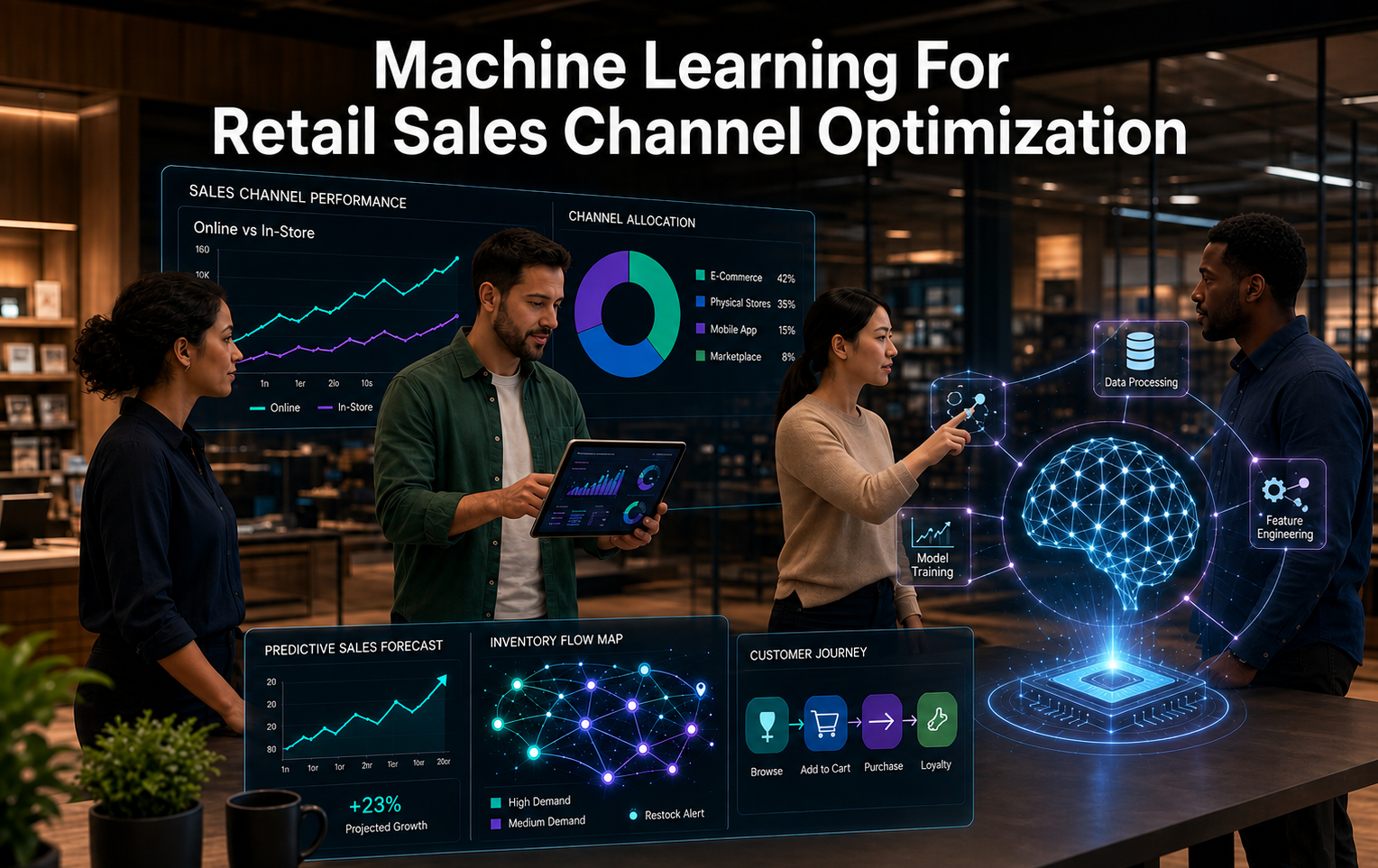
Retail customers rarely follow a single buying path. This interconnected behavior creates opportunities for retailers, but it also makes channel management more complex. Machine learning can help businesses understand how shoppers move across touchpoints, predict demand, identify profitable opportunities, and allocate resources more effectively. With the right data foundation and clear business goals, Retail Sales Channel Optimization can become a continuous process rather than a periodic reporting exercise.
Retail Sales Channel Optimization
How Does ML Support Channel Decisions?
Connected Channel Data Foundation
Retailers should connect transactions, browsing activity, product details, pricing, promotions, inventory, fulfillment events, customer interactions, and channel costs where appropriate. Consistent identifiers help teams connect records across systems without creating duplicate or misleading profiles. Data pipelines should also account for timing because delayed events can distort real-time decisions. Every team should understand whether revenue, margin, conversion, returns, and customer value metrics follow the same calculation rules across channels.

Store Network Optimization
Machine learning can help retailers understand differences in local demand, customer profiles, product preferences, traffic, and channel interaction. These findings can support assortment decisions, inventory placement, staffing, and store-level promotional planning. A location that generates modest direct sales may still contribute through pickup, returns, product discovery, or assisted purchases. Evaluating the full role of a store provides a more accurate picture of its contribution to the wider retail network.
Pricing And Promotion Optimization
Price and promotional decisions can influence channel behavior in different ways. A discount that works well online may produce a different response in stores because customers face different experiences, costs, and competitive conditions. Machine learning can estimate likely demand changes under alternative prices or promotional structures. Retailers can compare scenarios before launching campaigns and monitor results afterward. The objective should be profitable growth rather than volume alone. Margin, customer value, inventory position, and potential channel substitution all deserve consideration.

Digital Channel Optimization
Websites and mobile applications generate detailed behavioral signals that can reveal where customers struggle or disengage. Machine learning can identify search failures, product-view patterns, cart abandonment, recommendation performance, and conversion differences across devices or audiences. Predictive systems can prioritize likely causes of friction and suggest areas for testing. Retailers can then improve navigation, product information, search relevance, checkout flows, and recommendations. Digital optimization works best when teams combine behavioral evidence with direct customer feedback.
Demand Forecasting By Channel
Demand can differ significantly between a website, mobile application, store network, and marketplace. Ml can examine historical sales, seasonality, promotions, product relationships, location, browsing signals, and other suitable variables to estimate future demand for each route. More detailed forecasts can help retailers plan inventory and staffing at the right level. Channel-specific estimates can also reveal when apparent growth in one route represents a shift from another rather than genuine incremental demand.

Omnichannel Fulfillment And Channel Economics
A connected retail network must consider not only where a sale occurs but also how the order reaches the customer. Ship-from-store, click-and-collect, home delivery, marketplace fulfillment, and centralized distribution each carry different costs and service expectations. Machine learning can help evaluate which fulfillment route may balance speed, inventory availability, transportation expense, and customer promise. Channel economics should include marketing costs, payment fees, returns, handling, and service requirements. This broader view prevents teams from declaring a channel successful simply because it produces high top-line revenue.
Cross-Selling And Basket Expansion
Machine learning can identify product relationships that help retailers create relevant cross-selling opportunities. Models can examine purchase combinations, customer preferences, product attributes, and contextual signals to rank complementary items. Cross-selling should remain helpful and avoid overwhelming customers with unrelated options. Retailers can measure success through incremental margin and customer value rather than clicks alone.
Attribution And Incremental Value
Channel attribution attempts to understand how different touchpoints contribute to a purchase. Simple last-touch methods can undervalue earlier interactions that influenced consideration. Machine learning can analyze sequences of engagement and estimate contribution across multiple routes. Retailers should distinguish correlation from true incremental impact and use controlled experiments where practical. Better attribution can improve budget allocation because teams gain a clearer view of which channels create demand, which assist conversion, and which mainly capture customers who already intended to buy.
Attribution & Incremental Value
Channel attribution attempts to understand how different touchpoints contribute to a purchase. Machine learning can analyze sequences of engagement and estimate contribution across multiple routes. Retailers should distinguish correlation from true incremental impact and use controlled experiments where practical. Better attribution can improve budget allocation because teams gain a clearer view of which channels create demand, which assist conversion, and which mainly capture customers who already intended to buy.
Real-Time Monitoring
Retail conditions can change quickly during product launches, campaigns, unexpected events, or supply disruptions. Machine learning can monitor channel activity and identify unusual changes in traffic, conversion, orders, inventory, returns, or service requests. Automated monitoring should use sensible thresholds to prevent constant reactions to temporary noise. Human review remains valuable when deciding whether an anomaly represents a real commercial event.

Profitability And Resource Allocation
Sales growth does not always equal profitable growth. Each channel can carry different marketing, technology, fulfillment, payment, labor, return, and service expenses. Machine learning can help estimate expected contribution and identify where additional investment may create the strongest return. Retailers can use these insights to adjust budgets, inventory, staffing, and promotional resources. It is to understand their strategic role and allocate resources according to measurable value.
Privacy, Security, And Responsible Use
Channel optimization often involves customer and behavioral information, so responsible data practices must remain central to the program. Retailers should collect relevant information for legitimate purposes, apply suitable access controls, protect sensitive records, and respect applicable consent requirements. Responsible AI improves trust and reduces operational risk. Strong governance should accompany the analytical program from the beginning rather than appearing after deployment.

Conclusion
Retail Sales Channel Optimization works best when businesses treat stores, websites, applications, marketplaces, and fulfillment routes as connected parts of one customer ecosystem. The strongest results come from combining reliable information with appropriate models and experienced decision-makers. By building this foundation gradually, retailers can improve channel efficiency, increase customer relevance, and pursue growth with greater commercial discipline.